Friday, 20 January 2012

Falmouth International Maritime Museum

For the past few months I have been liaising with the International Maritime Museum in Falmouth in regards to supplying them with photography - both corporate and internally. Today was the day when this plan was realised, and together we have come to an agreement: I will work for the museum as a photographer on a part-time, freelance basis voluntarily, supplying the museum with everything from staff portraits to promotional shots when I feel like it. In return I am free to supply and sell any of these images to the Falmouth Packet (the local newspaper) through the Cartel agency here at the university if they need them. I am very happy with this arrangement - it means the museum are able to bring me in whenever they (or whenever I am free) and in return I get experience and something good to put on my CV (and hopefully some money from the newspaper). 

Today - as a sort of 'starter' shoot - I went to the museum to get some shots of them hanging some new boats in the museum's main hall. Below are the results. I shot with my Canon 450D and two speed lights.


Jake hulme hanging a GBR racing boat from the 2000 Sydney Olympics.

Employees Elliot Holmen (left) Jake Hulme (Centre) and Mel Sharp pose above the museum's main hall.  

Jake rigs up the GBR boat as Elliot and Mel look on.


Jake expertly controls the cherry-picker as he navigates across the museum floor.


S

Tuesday, 17 January 2012

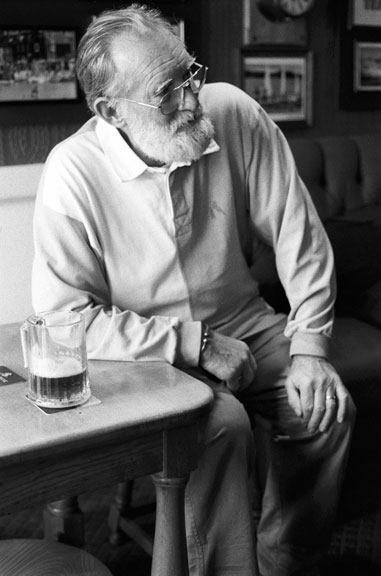
The Portrait element: David Shipley (35mm, B/W film)

Below are the four images of ex-marine engineer/competitive sailor David Shipley which I have chosen to submit as my final images for the Portrait Element brief...


Observed portrait - ambient light

Environmental portrait - ambient light

Detail - ambient light

Formal portrait - with Metz flash


S

Monday, 16 January 2012

Playing with the 7D

This weekend I visited some family in Gloucester - to be precise, it was my nan's 80th birthday. Now being considered the 'Family Photographer", I was asked by my aunt to take some shots of the party and the weekend in general. For this, I hired a Canon 7D and two speed lights from the photography stores here at the university. This was great fun, as I have never shot digital on anything above a 450D. Below are a few examples of what I took - mostly portraits and 'family snaps'. 


My brother Rob and his girlfriend, Grace Williams

My nan holding one of her gifts - a print by Suffolk print-maker Glynn Thomas


My Cousin (left) and a relative.

My cousin's dog, Murphy.

My uncle's dog, Sophy.


Rob and Grace.


Using the 7D and the flash lights was good experience, as a few of my forth-coming assignments will be required to be shot digitally.


S

Sunday, 15 January 2012

The Portrait Element: Glynn Thomas, images for submission

Below are the images of Suffolk print maker Glynn Thomas that I plan to submit to my tutor for consideration as final images in the Portrait Element assignment...

Environmental portrait - with Metz flash

Formal portrait - with Metz flash

Detail - ambient light

Observed portrait - ambient light

Saturday, 7 January 2012

The Portrait Element: Manningtree Sailing Club - David Shipley and Sid Smith

On Thursday 5th January, I visited Manningtree Sailing Club to photograph David Shipley - an ex-marine engineer now 18 years' retired. He is an acquaintance of my grandfather's, who is heavily involved with the club and all things nautical. We met at the Manningtree Sailing Club clubhouse, where, over  a couple of pints of Adnams, we discussed his history of sailing and involvement with the club. Below are a couple of examples of some digital work I produced on the day - as with the rest of my portrait sessions, I will not be able to process any of the films until I return to University (which is tomorrow, thankfully). Throughout this shoot I used  my Canon 450D DSLR and Olympus OM - 2n (35mm film), along with a Metz flashgun. 

David Shipley


Shipley was a keen sailor in the past, competing in numerous national and international races - the largest being the North Sea Passage race, which he entered a total of seven times and won twice. He also won the London Frostbite race three times - a race which takes competitors 32 miles along the River Thames, starting at Tower bridge and ending at Erith Yacht Club. His hay-day was cut short, however, due to the un-timely death of his friend during a boating race in Holland. Since then, Mr. Shipley has merely dabbled in sailing, buying and refurbishing a small fleet of traditional fishing boats and selling them. In between this and sporadic pheasant-shooting excursions, David has battled with cancer and is the full-time carer of his mother, who, regrettably, is otherwise incapable of looking after herself.       


David showing me a picture of his dingy on his mobile phone.


Sid Smith

Whilst photographing David, I took the opportunity to make some portraits of my Grandfather, Sidney Smith.  I have not as yet had the opportunity to undertake portraiture with a member of my family, and I found that the personal relationship made for far more successful and intimate portraits. Like David, my grandfather was, and still is, a keen sailor and an exceptional advocate of the Manningtree Sailing Club. 


Above are three of my favourite digital portraits from the day - in particular the middle and bottom portraits. I think that these are the most successful because they show the estuary map in the background - the Stour estuary being a huge part of Sid's life, which gives context to his extensive history and his love of the landscape. 


Sid posing next to his yacht

I am really happy with the results of this shoot, and I would like to carry out more photographic documentations of my family in the near future - the personal aspect of the subject matter created a very close emotional connection between me and the photographs, and a great sense of pride in the images. For now, however, I need to concentrate on my University projects at hand, which require me to deal with subjects who I am not familiar with.


Reading poetry


S

Monday, 2 January 2012

Nina Berman

Nina Berman

Nina Berman is a documentary photojournalist with a particular Interest in American political and social landscape. Her work has been widely published, exhibited and collected, receiving awards in art and journalism from the New York Foundation for the Arts and the World Press Foundation. Her images of wounded American war veterans have become recognised internationally through solo exhibitions in galleries such as the Dublin Contemporary and Princeton University.

Purple Hearts

Purple Hearts is a body of work consisting of portraits of wounded American soldiers photographed in their homes, military hospitals and bases across the U.S.A. The Images are part of book published by Trolley books.


I find Berman’s use of light very interesting, using both artificial and ambient light to illuminate her subjects. The portraits were shot using medium format film, which results in portraits of stunning quality and colour – as seen on the above left image, the use of film produces vivid colours which really captivate the viewer; the scene of the veteran standing outside his home almost seems surreal and artificial, with the man’s semi-bionic arm emphasising this. On the contrary, the above right portrait, shot through a piece of glass or plastic, has a far more human feel due to the use of softer or ambient light. The subject is lit from one angle only, casting the right side of her body in shadow. This, and the fact the portrait was shot through the glass mottled by condensation and dirt, gives rise to a great sense of humanity and sombreness. For me, the barrier in front of the subject acts as a metaphor which represents the physical barrier he will be facing for the remainder of his life.

9/11 – afterglow

After the attacks on the world trade centre, Berman was on hand to photograph the aftermath of the event. The series was shot on 35mm black and white film, and are presented side by side to create semi-panoramic views.


I think that the idea to put present the photographs side by side creates some interesting effects, with one image leading on to the next, often blurring the boundaries. However, sometimes the effect is a bit over-powering, and I feel that the meaning is somewhat lost on certain occasions – for example the above images of the Stock Exchange partnered with a shot of some rubble. I think the fact that the two images are so busy creates a problem – when they come together it often becomes very difficult to view them as single images. I think in comparison with other work of the same subject, Berman’s photography is quite weak – Joel Meyerowitz’s body of work dealing with the aftermath of 9/11 deals with the event in a far more in-depth and emotional manner. I believe that this problem is all a matter of access – Meyerowitz was the only photographer in the world who was given access to the Ground Zero site where the workers were clearing the site.

Joel Meyerowitz - Aftermath 


By gaining full access to Ground Zero, Meyerowitz managed to create photographic profiles of the workers themselves, through portraiture and candid shots, to give a far more human feel to the events. This sense of humanity is something that Berman unfortunately does not capture in her work due to her lack of such intimate access.              

S 

Ivor Prickett

Ivor Prickett

Irish-born documentary photographer Ivor Prickett dedicates his time to completing long-term photographic projects, whilst at the same time carrying out editorial assignments for a wide range of international clients. Prickett has worked on numerous projects, and is particularly interested in post-war areas dealing with the aftermath of conflict. Currently, Prickett is based in the Middle East where he has been documenting th revolutions in Egypt and Libya.

Portraits

Amongst his documentary photo-stories, Prickett carries out many commissioned portraiture shoots for various magazines, newspapers and journals – including the Sunday The National, the Saturday and Sunday Telegraph, and Fader magazine. The majority of these portraits are shot on medium format.


This is one of my favourite portraits by Prickett. It is of top Syrian Jockey Bourhan Sallah after winning a race at Latakia racecourse in North-Western Syria as part of a body of work commissioned by The National magazine. I think that this is a very simple but brilliant portrait, with a spacious frame and ambient light. The use of colour by Prickett picks up on the brightness of the jockey’s yellow uniform, which immediately catches the eye amongst the more conservative hues. There is a great sense of direction in this photograph, too, even though it is a static shot – the lines cut in to the sand to form the racecourse are emphasised by the white fence which runs adjacent to it, leading the eye inwards towards the subject. This is all contained in the square frame of the medium format exposure, which helps to give a sense of equality and completion which makes the portrait that more compelling.

Free Libya

The Libyan uprising started in mid-February 2011, at the peak of the ‘Arab Spring’, following the example of countries such as Tunisia and Egypt. Prickett travelled to Libya twice during this time, witnessing brutal fighting and its aftermath, as well as the “eerie normality” that descended on the country as it became clear that Col Gaddafi would not go down easily.


 As with his portraiture, Prickett documented the Libyan conflict with a medium format film camera, capturing the events in stunning clarity and colour. I chose this shot of rebel forces – reacting to incoming shells fired by Gaddafi’s loyalists – as an example because it shows the extremely dangerous and difficult conditions Prickett would have been working under – especially when using a medium format film camera. The results, however, were definitely worth the effort, as what ensued are a fantastic set of images that document the uprising in a whole new way. The decision to use medium format film instead of a 35mm digital SLR shows the conflict in stunning quality and colour, picking up on the details and hues that are abundant in the Libyan landscape: the arid desert sand and rock; the dark hues of the weaponry and vehicles; the deep blues of the immaculate Middle Eastern skies. The above shot is in fact not my favourite image of Prickett’s from the set, but it is the best example of his dedication and talent as a photojournalist to shoot with medium format in extremely dangerous conditions – for that, I respect Prickett a lot and I look forward to seeing more work of house in the future.   


S