Showing posts with label people. Show all posts

Sunday, 8 April 2012

A Shot in the Dark, magazine layout MKII

After deciding that I was not happy with my previous layout, which had too much text and not enough emphasis on the images, I have produced a revised version of my magazine layout for my story on blind shooting. I believe that the layout is far more simple, with not too much text. Discuss. 

S


Thursday, 29 March 2012

A thatcher's touch...

Being at home for the Easter break has softened me somewhat - too much free food and a rather comfortable bed can be blamed for that. So much so that it begun to feel like too much of a task even to sit here an write rubbish that most people probably don't care about. So I decided to throw myself out of the house and go looking for a shoot for my most recent of projects based around the idea of 'touch' (an idea which I wanted to base around trade and crafts). Unfortunately where I live is the sticks, and at first glance it would appear that nothing happens at all; a far cry from Falmouth where one is virtually tripping over interesting people and trades. However, after an hour of aimless wandering (which culminated in me sitting in an empty field full of sheep and dropping a Lastolite reflector in a river) I came across Allan Seabrook working on a thatch in the centre of my village. Perfect. 

I put my best 'interested voice' on and introduced myself and explained my intentions. I was photographing the next day, which came as a surprise to me; always the sceptic I was expecting to run in to a wall of bureaucratic excuses and issues with another health and safety-obsessed tradesman who thinks that I am incapable of climbing a ladder without killing myself. Thankfully I was wrong (which appears to be the case with many of my numerous prejudgements), and neither Allan nor the home-owners had a problem with me photographing him at work. A lesson for you kids - never be afraid of asking. Tune in next week for more of my insightful proverbs...

And so begun my first ever foray in to the world of traditional roof thatching... Which started with a quick spin on the interweb...

Thatching is an extremely old and traditional craft which originated in equatorial countries such as Hawaii, Fiji, Kenya and Korea. Thatching - although it is applied and practised in a multitude of ways - is fundamentally the building of a roof using dry vegetation; straw, water reed, sedge, rushes and heather being the most commonly used. Layering the vegetation as to shed water away from the inner roof of a building, it was only way of roofing available to the majority of the UK and Europe until the late 1800s, when the mass production of Welsh slate provided a stabler material which could be distributed on a wide scale thanks to the proliferation of canals and railways.

Now - in the UK especially - thatching has become a matter of choice; that choice mostly being made by the affluent who enjoy keeping a traditional look to their homes, that want a more ecologically friendly roof, or that have bought an already thatched building. In my home county of Suffolk, one of the few counties in Britain which still maintains a significant number of thatched-roof houses, the specialist trade passed from generation to generation is still a viable and lucrative business - the thatch of an entire roof will cost upwards of a few tens of thousand pounds, depending on the tradesman. One such tradesman is Allan Seabrook, who has been a sole trader for nine years.


Allan became his own boss after completing a five-year thatching apprenticeship, and from the couple of brilliantly sunny days I spent up the scaffolding with him it doesn't seem like such a bad idea. A back up plan for if my career in photojournalism goes to the dogs perhaps...


Tools of the trade: a mallet, shears, a metal steak and a ladder are some of the surprisingly few tools required to create a thatch.

Bendable lengths of wood known as spars act as safety pins when layering the straw.

Sharpening a spar

The aforementioned thatching trade is a traditional one, with techniques being passed down by generations of workers and with apparently no set way of style or terminology - for example, Allan finishes his roof with block ridges, the shape of which are specific to each tradesman. To Allan, they are known as 'scollops'; however this is not true for every thatcher, he just got the name from his teacher, and having never written the word down he couldn't even tell me how it was correctly spelt. This style of 'block ridging' came about during Victorian times, whereby having the thatch ridge finished with a cut shape became fashionable - original thatch ridges would be flush to the rest of the roof. 


Allan begins cutting his block ridge, or 'scollop', by cutting away a its outline. 

The block is then trimmed and shaped according to its position on the roof - each scollop must look as level and equally-sized as possible when seen from ground level. 

The completed block. This particular shape was passed down to Allan by his teacher during his days as an apprentice. No two blocks are the same, and each block ridge style is specific to the craftsman.

I have to say this was one of my more relaxed shoots since being at university - having the location about two minutes from my house made things particularly favourable, and with the recent spate of beautiful weather I may have run the risk of getting a tan in the process. As is the life of a country thatcher (see what I did there?).


With a little hope a few of these images may end up in the Cavendish Magazine, a world-renowned publication spanning all aspects of village life...

S

Sunday, 11 March 2012

recent work for the newspaper...

Gyllyngvase Tennis Courts

This group of pensioners have been playing at Gyllyngvase Tennis Courts for over thirty years - since local resident Barbara Truswell founded the club. The courts - which are currently run by the Falmouth Beach Hotel - are available for public use. Now, however, there are fears of them being taken over by St. Michael's Hotel across the road, potentially putting it in to privatisation, meaning the end of the thirty-five-year-old club.


S

Saturday, 10 March 2012

magazine spread mock-up, MKII...

The revised version of my mock magazine spread, words and all (although I'm not sure if I am 100% happy with them just yet, but the layout is about right). Enjoy!

S


Joe Stinton: a shot in the dark

Last week I completed my story of Joe Stinton, a thirty-seven-year-old blind shooter from Helston, Cornwall. Joe shoots every Wednesday afternoon at Helston and District Rifle Club as part of the Cornwall Blind Association's club programme which started in 2002 (the club itself was originally set up in 1939, and is still used to this day for amateur shooters young and old).

Joe is an incredible man, and an extremely talented shooter; but he hasn't been blind from birth. As I found out upon the second time of meeting him, Joe had his sight for nearly thirty years prior to going blind. An unimaginable event, which took place in 1998, meant Joe would be rendered completely blind for the rest of his life.


Joe is both diabetic and wheat intolerant (two conditions which are often thought to go hand-in-hand). It was around the first anniversary of his marriage that he had a severe reaction to wheat, hospitalising Joe immediately. To help with the reaction - which saw Joe in a coma on the day of his anniversary - he was administered immunosuppressant drugs. However, whilst in most cases people with their immune systems down are required to stay quarantined in the hospital (for example after a kidney transplant), Joe was discharged, and allowed to walk free with a severely weakened immune system. It was then that Joe contracted septicaemia, a form of blood poisoning which, in severe cases, can result in blindness. Joe would never see again.

But he does not dwell on it, and is grateful for having "built up a good life" and "met some amazing people". "I have done a lot of things which I wouldn't have if I hadn't lost my site" said Joe of the fact that, apart from shooting, he has cycled tandem from John O'Groats to Land's End. 


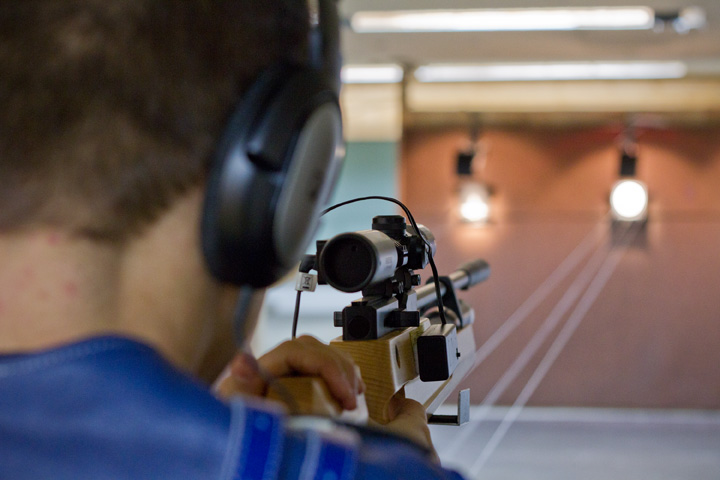
Joe relies on a laser fixed to the gun's barrel  to 'see'. The laser points towards the target, resulting in a high pitched noise to be relayed to the headset; the higher the pitch, the closer he is pointing to the centre of the target. Once all his shots are fired, the target is pulled back to the Joe via the rope and pulley system for inspection.   


There are two disciplines in blind shooting: Supported and Unsupported. Quite self-explanatory, Supported shooting is with the use of a tripod and a chair; Unsupported is with neither. Of course, shooting unsupported is far harder, and only Joe and one other shooter at the club are skilled enough to do it. 


Joe's gun


Joe has been shooting since 1999, stopping only momentarily when his child was born. He has been selected twice to compete in the World Championships, and last Friday he competed, along with the rest of the Helston team (which consists of around eight other blind/visually impaired shooters), at the British Blind Shooting Championship in Wolverhampton.


Keith Busby is Joe's 'helper', guiding him only for manoeuvres which require more dexterity than average - for example: as he moves from the waiting room to the shooting range, loading the gun, and the initial aiming of the rifle.  


Helper Kieth Busby acts as Joe's eyes when initially aiming the gun towards the target. After that, it is all down to Joe.


Keith inspects Joe's target after a round of shooting.


A perfect score of fifty. Joe gets five shots before the round is over; the bullseye is worth ten points. During competition, however, the competitors only have two shots per target, with thirty targets to hit under timed conditions. 


This series of photographs will be edited down to just a five-picture story for my 'Fragile' assignment. My next assignment will be based around the idea of 'Touch'. 

S


Wednesday, 29 February 2012

seeing the blind...

Today I spent the afternoon at a visually impaired shooting session at Helston and District Rifle Club with Joe Stinton, a thirty-seven-year-old man who lives in Helston, a small town outside of Falmouth. Unlike the majority of the shooters present today, Joe is completely blind. Despite this, he has been shooting since 1999, stopping only momentarily when his child was born. He has been selected twice to compete in the World Championships, and on Friday he will be joining the rest of the Helston team to compete at the British Blind Shooting Championship in Wolverhampton.


Joe relies on a laser fixed to the gun's barrel  to 'see'. The laser points towards the target, resulting in a high pitched noise to be relayed to the headset; the higher the pitch, the closer he is pointing to the centre of the target. Once all his shots are fired, the target is pulled back to the Joe via the rope and pulley system for inspection.   


There are two disciplines in blind shooting: Supported and Unsupported. Quite self-explanatory, Supported shooting is with the use of a tripod and a chair; Unsupported is with neither. Of course, shooting unsupported is far harder, and only Joe and one other shooter at the club are skilled enough to do it. 


Helper Kieth Busby acts as Joe's eyes when initially aiming the gun towards the target. After that, it is all down to Joe.


A perfect score of fifty. Joe gets five shots before the round is over; the bullseye is worth ten points. During the competition this weekend, however, the competitors will only have two shots per target, with thirty targets to hit under timed conditions. 

Joe is surprisingly efficient at manoeuvring, and only needs help when traversing larger distances and attempting tasks which require more dexterity than average.  


Joe celebrated his thirty-seventh birthday two days ago.


This was a fascinating shoot to say the least, and I think Joe is a brilliant guy. He was more than happy for me to be there and we are meeting again next week, at which time I plan to capture more of his day-to-day life. 

S