Showing posts with label british. Show all posts

Friday, 25 May 2012

Olympic Torch Relay 2012/UCF Graduate Fashion Show

So here it is. Some actual decent content for the first time since... well since a long time ago. I thought about giving each topic its own individual post, but I figured it would make more of a feast to have it all in one. Aren't I thoughtful? 


Olympic Torch Relay - 19.05.2012

First things first are first - and the first day of the 2012 Olympic Torch Relay came and went last week on the 19th May. All things considered, it was a very successful day. Now I'm not really all about the 'campaigns' and sickeningly colourful propaganda that the London Games has produced thus far, but there was a certain excitement this day: an anticipation being released after months in the making. It was, above all else, great fun to photograph.


The sun was shining and patriotically-dressed members of the public were out in droves. Coincidently, to cover the day, there was a crack team of 16 Cartel Photos photographers stationed strategically across Falmouth, myself being one of them. Our primary client was Rex Features, a London-based press agency and picture library with whom UCF have close links. Our brief was to document - 'document' being a byword for running around like lunatics - the day, and to converge later in a designated media room in The National Maritime Museum. The majority of our photographers were positioned on the ground; I, on the other hand, was casually hanging out the second floor window of my tutor's apartment overlooking the Falmouth high street. This was a fairly unique perspective and gave me the opportunity to experiment with a few more atypical press shots. Death from above!


UCF Graduate Fashion Show 2012 - 23.05.2012

Another Event being covered by Cartel Photos was the University College Falmouth Graduate Fashion Show, held at The Fish Factory in Penryn. I was on hand to photograph the show along with five other Cartel photographers. This was my first shoot that has had any sort of relation to fashion, and I have to say that it was pretty damn intense: lots of loud music, bright lights and plenty of beautiful people.


The creative aura of the event made for some extremely interesting photographs. Of course, it also helped that I had a centre spot on the press podium directly opposite the end of the catwalk.


Well, that's all I can be bothered to post/say. I am currently sitting at my  computer with half of my right arm in a cast after breaking a bone in my wrist yesterday foolishly falling off my bike. It hurts and typing is a bit of a struggle. Stay tuned for more updates. 

S

Tuesday, 24 April 2012

A catch up on all things photographic or otherwise.

Evening all (or morning, rather, as it is approaching 1am as I write this). Things have been stacking up rather a lot recently - Uni. work, exhibition planning and generally having a life - and so updating my blog has taken somewhat of a back seat. It has been over a week now since I have written anything on here, and quite frankly I feel guilty. Perhaps this is a state of mind I should be worried about, feeling guilty for not talking to a computer, and I should possibly contact a psychiatrist. Anywho. This post is to catch up on the rather large backlog of news, information and thoughts from the past couple of weeks.

Let's start with a couple of said thoughts. Over the past few weeks I feel I have discovered a few things about myself - or rather about how I relate myself to photography. It all started when a friend of mine came very close to leaving the Press & Editorial Photography course; the reasons: because so far we have simply been filling crappy sketchbooks to meet deadlines; because photojournalism appears to be too exploitative; and that the photography industry is apparently full of arseholes. A fair critique, I felt. It got me thinking, too, about whether this was the right place for me. Sure, I have been having a great time meeting interesting people and learning a myriad of new skills, but what was I actually achieving? Like my friend, I had thus far only been shooting work for the briefs, and not shooting anything personal for myself. Furthermore - as we engaged in many disparate conversations about the world of photojournalism - it was becoming increasingly apparent that photography is one of the most egocentric mediums, with a who-owns-the-best-camera mentality giving birth to a breed of people who seem to think that because they are a 'photojournalist' they have the right to poke their lens in to other peoples' private affairs. And I should know - I've done it myself. The very project I am working on at the moment appears to be everything I have come to dislike about certain aspects of photojournalism.


The aforementioned project is about the homeless of Newquay (and everything surrounding their lives), with the hopeful intention of shedding light upon an area often fogged with doubt and uncertainty. I have also begun to photograph the lives of young adults (16-25) who have either run away from or have been forced to leave their homes. Instead, they live in a small flat in the centre of Newquay as part of what has become known as 'The Turnaround Project', or 'Turnaround' for short. Turnaround - a Christian organisation - aims to accommodate, rehabilitate and educate the youngsters, as well as teaching them to be self-sufficient around the home and their general lives. The images so far go a little something like this:


As I mentioned before, I have been having somewhat of an inward-facing battle with myself over the past few weeks about the ethics of this. In one hand the Turnaround Project are happy for me to be there, and the youngsters themselves appear to be comfortable. But as I thought about how I first introduced myself to their lives, I realised just how ridiculous it sounded. I am conducting a 'project' - I have also come to dislike categorising people as 'projects', but it will do for now until I can think of a better word to apply - on the homeless population of Newquay, ranging from rough sleepers to, in the case of Turnaround, the accommodated, but all are without any real 'home'. What, then, has given me the right photograph these people? These people who, in relation to me, have nothing (although the youngsters at Turnaround have come to call the apartment home, it is not exactly the same deal). When I really think about it, the only reason why I chose to do this 'project' was because I simply got lucky with the access way back in February. But to tell you the truth, I believe I have matured as both a person and a photographer since then, and I that simply "having access" doesn't constitute a reason for carrying out a 'project'. I want to do a project about something that I feel moves or inspires me - not that a lot of what I have seen doesn't inspire me, I have met some amazing people - but, and again I go back to the reason why I started this in the first place, I don't feel as though I truly deserve their attention. It is almost as if I am making a story just becuase of their position in life, which makes me feel very uncertain as a photographer. These days, I find that the stories that hold me the most are not this which document hard core subjects such as homelessness, but smaller stories which make you think - "wow, I had no idea such people existed". A great example of this is a recent piece by r Jono Rotman, who produced some amazing - but simple - portraits of the Mongrel Mob, a New Zealand-based gang. This work for me made me realise just how effective a simple body of work can be.

Back to the matter at hand, and of course, if I could help any of these people in some way I would be extremely happy. In fact things are already beginning to take shape in regards to different charities. I have recently been in contact with a representative of Emmaus UK, one of the biggest homeless charities. Conversation has started in regards to exhibiting my work as a fund-raising tool as well as general propaganda. And that, I think, would give me the right to photograph these incredible people.

As far as everything else is concerned, things are going swimmingly, albeit extremely busy. My year and I are ploughing ahead with exhibition planning, with the whole thing starting to shape up rather nicely. Follow this link to the Pig House Pictures Facebook page (see previous post for details on that). We have also organised a smashing after-party to be held at Toast in Falouth to really see-off the opening night of our first year exhibition (which will be on display at the Royal Cornwall Polytechnic Society from the 8th - 14th May). As well as all that, we also have plans for a pocket-sized publication in the pipeline; more on that to follow soon!

Oh, and before I forget, I have photographed my first wedding! ("Hoorah", "Hazzah!"). The big day was last weekend, in fact, and was a friend of mine's in Newquay. It was quite a nerve-racking day to say the least, and needless to say I learnt a fair few lessons in photographic management! But enough spiel for now, stay tuned (if anyone does indeed 'tune' to this) for wedding photographs galore. I'm not entirely sure if I should be admitting such a thing on a photojournalism blog.

S

Sunday, 11 March 2012

recent work for the newspaper...

Gyllyngvase Tennis Courts

This group of pensioners have been playing at Gyllyngvase Tennis Courts for over thirty years - since local resident Barbara Truswell founded the club. The courts - which are currently run by the Falmouth Beach Hotel - are available for public use. Now, however, there are fears of them being taken over by St. Michael's Hotel across the road, potentially putting it in to privatisation, meaning the end of the thirty-five-year-old club.


S

Saturday, 10 March 2012

Joe Stinton: a shot in the dark

Last week I completed my story of Joe Stinton, a thirty-seven-year-old blind shooter from Helston, Cornwall. Joe shoots every Wednesday afternoon at Helston and District Rifle Club as part of the Cornwall Blind Association's club programme which started in 2002 (the club itself was originally set up in 1939, and is still used to this day for amateur shooters young and old).

Joe is an incredible man, and an extremely talented shooter; but he hasn't been blind from birth. As I found out upon the second time of meeting him, Joe had his sight for nearly thirty years prior to going blind. An unimaginable event, which took place in 1998, meant Joe would be rendered completely blind for the rest of his life.


Joe is both diabetic and wheat intolerant (two conditions which are often thought to go hand-in-hand). It was around the first anniversary of his marriage that he had a severe reaction to wheat, hospitalising Joe immediately. To help with the reaction - which saw Joe in a coma on the day of his anniversary - he was administered immunosuppressant drugs. However, whilst in most cases people with their immune systems down are required to stay quarantined in the hospital (for example after a kidney transplant), Joe was discharged, and allowed to walk free with a severely weakened immune system. It was then that Joe contracted septicaemia, a form of blood poisoning which, in severe cases, can result in blindness. Joe would never see again.

But he does not dwell on it, and is grateful for having "built up a good life" and "met some amazing people". "I have done a lot of things which I wouldn't have if I hadn't lost my site" said Joe of the fact that, apart from shooting, he has cycled tandem from John O'Groats to Land's End. 


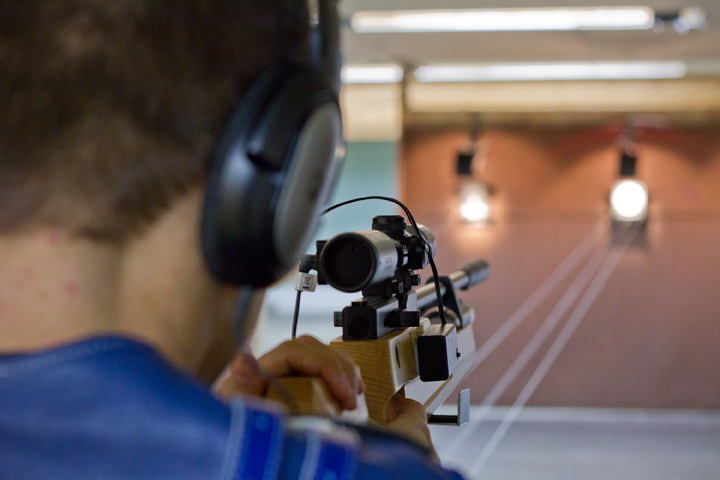
Joe relies on a laser fixed to the gun's barrel  to 'see'. The laser points towards the target, resulting in a high pitched noise to be relayed to the headset; the higher the pitch, the closer he is pointing to the centre of the target. Once all his shots are fired, the target is pulled back to the Joe via the rope and pulley system for inspection.   


There are two disciplines in blind shooting: Supported and Unsupported. Quite self-explanatory, Supported shooting is with the use of a tripod and a chair; Unsupported is with neither. Of course, shooting unsupported is far harder, and only Joe and one other shooter at the club are skilled enough to do it. 


Joe's gun


Joe has been shooting since 1999, stopping only momentarily when his child was born. He has been selected twice to compete in the World Championships, and last Friday he competed, along with the rest of the Helston team (which consists of around eight other blind/visually impaired shooters), at the British Blind Shooting Championship in Wolverhampton.


Keith Busby is Joe's 'helper', guiding him only for manoeuvres which require more dexterity than average - for example: as he moves from the waiting room to the shooting range, loading the gun, and the initial aiming of the rifle.  


Helper Kieth Busby acts as Joe's eyes when initially aiming the gun towards the target. After that, it is all down to Joe.


Keith inspects Joe's target after a round of shooting.


A perfect score of fifty. Joe gets five shots before the round is over; the bullseye is worth ten points. During competition, however, the competitors only have two shots per target, with thirty targets to hit under timed conditions. 


This series of photographs will be edited down to just a five-picture story for my 'Fragile' assignment. My next assignment will be based around the idea of 'Touch'. 

S