Last week the first year Press & Editorial Photography course were given a twenty-four-hour assignment; the brief was to create 'a portrait of Plymouth'. As the name suggests, we had had one day to complete this (yesterday, in fact). We needed to find an alternative side - or something unusual - to Plymouth that people do not see everyday (for example that lovely water feature in the town centre). We had to phone ahead, organise shoots and be generally organised. When we were finished, we had to upload, edit and FTP the files (metadata and all) to Ashley, who is the administrator at Cartel Photos.
This assignment was designed to take our skills in to a faster 'Press style' of working, much like it would be in the professional industry.
My chosen subject was Mike Gibson, a Plymouth-born, Halshaw-educated, ex-Royal Navy fleet air arm engineer. Since retiring he has become a committed member of the Plymouth community, acting as a trustee for the Widewell Association as part of a team which maintains Ebberston Millenium Park, a public space just outside of Southway, Plymouth. Mike has become a local celebrity recently since commencing a personal vendetta against fly-tipping in the suburban estate of Southway.
 |
Mike sitting in his conservatory at his home in Southway, Plymouth. To his left is a photograph of the HMS Ocean, a destroyer that Mike served on during his time in the Royal Navy.
|
Mike started voluntarily litter picking after his doctor recommended he walk two miles a day following a major heart bypass operation. During his excursions he noticed that worryingly large amounts of rubbish lay strewn across the pavements of Southway. Now, through recent exposure in the Plymouth Herald, help from the council is beginning to present itself. However, there is still a big problem with litter in Southway, as Mike explained...
 |
| Mike holding the Plymouth Herald. On the front page is a recent article about his litter picking excursions. |
 |
| A litter bin which Mike filled with fly-tipped rubbish just two days before. The contents still remain. |
 |
| In the car park of the Paper Converting Company, Mike points out a particularly bad area for fly-tipping amongst the warehouses of a Southway industrial estate. In his hand he holds a scrapped bike helmet. |
Crates of opened, unopened and discarded beer and wine; a cardboard box filled with French rolls; mattresses; a gun. These are just a few of the items which Mike has recently discovered discarded in to the road-side bushes, industrial estates and bus shelters of Southway. He described it as 'disgraceful'. Mike's vendetta against fly-tipping in Plymouth has only just begun; however, at 86 years' old, he cannot keep on litter picking like he has. His eyesight is deteriorating, and walking is difficult. It's not over yet, though, he says. Since his exposure in the Plymouth Herald, Mike has been interviewed by Radio Devon and even ITV News. Things are starting to gather momentum.
 |
| Mike points out a dumped bin bag filled with litter in a road-side bush. "Who knows what's inside that" he said. |
 |
| Mike shows me the Langley Estate, an area unfortunately heavily affected by the dumping of household waste. |
Cleaning up the streets of Southway is not all that Mr. Gibson cares about. Soon after arriving at his home, I discovered that he is an ex-fleet air arm engineer for the Royal Navy. Starting as a radio mechanic, Mike worked his way up the faculties until he enlisted in the Navy in 1945, ending up on the HMS Ocean as Lead Mechanic.
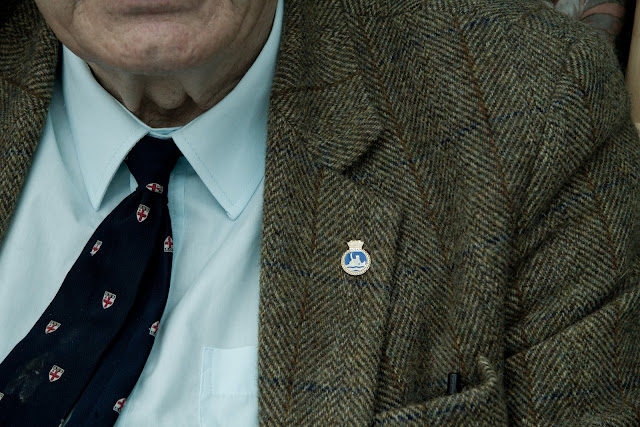 |
| A badge which Mike obtained from serving on the HMS Ocean - after training as a radio engineer and joining the Royal Navy in 1945 - is permanently pinned to his jacket. He acted as Lead Mechanic on the ship; shortly after he became the Petty Officer |
 |
| The HMS Ocean badge. |
 |
| A collection of badges from ships that Mike has previously served on hangs on a wall in his home. |
Mike and his family have a deep-seated history within the Navy; his father enlisted in the 1800s, and served on the HMS Sturdy as Engineer Officer in the early 1900s. Mike told me of how his father's ship at the time, the HMS Sturdy, ran aground off the coast of Tiree, a small island which resides in Scottish waters. Mike's father was not fatally injured, but in 1945 he organised the construction of a memorial on the island to commemorate those who had lost their lives in the wreck. Affected family members and friends were invited.
 |
| On an atlas map of Scotland, Mike points out the island of Tiree, where his father was injured as his ship, the HMS Sturdy, ran aground. |
 |
| Mike shows me an old photograph of himself whilst he was at school, wearing a classic 'blue coat' uniform. In the background, a similar portrait of his wife sits on the window ledge. |
 |
| Mike and his wife Barbara have been married for 56 years. |
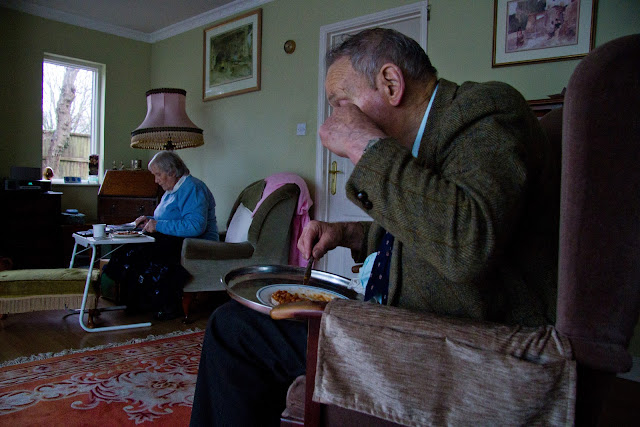 |
| Mike and Barbara sit down in their living room for a lunch of beans and toast and a cup of tea. |
At 86 years' of age, Mike's eyesight is slowly deteriorating so driving is impossible; a buss pass enables him to be mobile in his attempts to rally the City Council in to changing the way they deal with fly-tipping in the Southway area. He has already gathered momentum through his recent exposure in the Plymouth Herald and other news organisations, and more and more support is presenting itself. For the Navy veteran, it is now a matter of time and bureaucracy.
S