Showing posts with label community. Show all posts

Tuesday, 24 April 2012

A catch up on all things photographic or otherwise.

Evening all (or morning, rather, as it is approaching 1am as I write this). Things have been stacking up rather a lot recently - Uni. work, exhibition planning and generally having a life - and so updating my blog has taken somewhat of a back seat. It has been over a week now since I have written anything on here, and quite frankly I feel guilty. Perhaps this is a state of mind I should be worried about, feeling guilty for not talking to a computer, and I should possibly contact a psychiatrist. Anywho. This post is to catch up on the rather large backlog of news, information and thoughts from the past couple of weeks.

Let's start with a couple of said thoughts. Over the past few weeks I feel I have discovered a few things about myself - or rather about how I relate myself to photography. It all started when a friend of mine came very close to leaving the Press & Editorial Photography course; the reasons: because so far we have simply been filling crappy sketchbooks to meet deadlines; because photojournalism appears to be too exploitative; and that the photography industry is apparently full of arseholes. A fair critique, I felt. It got me thinking, too, about whether this was the right place for me. Sure, I have been having a great time meeting interesting people and learning a myriad of new skills, but what was I actually achieving? Like my friend, I had thus far only been shooting work for the briefs, and not shooting anything personal for myself. Furthermore - as we engaged in many disparate conversations about the world of photojournalism - it was becoming increasingly apparent that photography is one of the most egocentric mediums, with a who-owns-the-best-camera mentality giving birth to a breed of people who seem to think that because they are a 'photojournalist' they have the right to poke their lens in to other peoples' private affairs. And I should know - I've done it myself. The very project I am working on at the moment appears to be everything I have come to dislike about certain aspects of photojournalism.


The aforementioned project is about the homeless of Newquay (and everything surrounding their lives), with the hopeful intention of shedding light upon an area often fogged with doubt and uncertainty. I have also begun to photograph the lives of young adults (16-25) who have either run away from or have been forced to leave their homes. Instead, they live in a small flat in the centre of Newquay as part of what has become known as 'The Turnaround Project', or 'Turnaround' for short. Turnaround - a Christian organisation - aims to accommodate, rehabilitate and educate the youngsters, as well as teaching them to be self-sufficient around the home and their general lives. The images so far go a little something like this:


As I mentioned before, I have been having somewhat of an inward-facing battle with myself over the past few weeks about the ethics of this. In one hand the Turnaround Project are happy for me to be there, and the youngsters themselves appear to be comfortable. But as I thought about how I first introduced myself to their lives, I realised just how ridiculous it sounded. I am conducting a 'project' - I have also come to dislike categorising people as 'projects', but it will do for now until I can think of a better word to apply - on the homeless population of Newquay, ranging from rough sleepers to, in the case of Turnaround, the accommodated, but all are without any real 'home'. What, then, has given me the right photograph these people? These people who, in relation to me, have nothing (although the youngsters at Turnaround have come to call the apartment home, it is not exactly the same deal). When I really think about it, the only reason why I chose to do this 'project' was because I simply got lucky with the access way back in February. But to tell you the truth, I believe I have matured as both a person and a photographer since then, and I that simply "having access" doesn't constitute a reason for carrying out a 'project'. I want to do a project about something that I feel moves or inspires me - not that a lot of what I have seen doesn't inspire me, I have met some amazing people - but, and again I go back to the reason why I started this in the first place, I don't feel as though I truly deserve their attention. It is almost as if I am making a story just becuase of their position in life, which makes me feel very uncertain as a photographer. These days, I find that the stories that hold me the most are not this which document hard core subjects such as homelessness, but smaller stories which make you think - "wow, I had no idea such people existed". A great example of this is a recent piece by r Jono Rotman, who produced some amazing - but simple - portraits of the Mongrel Mob, a New Zealand-based gang. This work for me made me realise just how effective a simple body of work can be.

Back to the matter at hand, and of course, if I could help any of these people in some way I would be extremely happy. In fact things are already beginning to take shape in regards to different charities. I have recently been in contact with a representative of Emmaus UK, one of the biggest homeless charities. Conversation has started in regards to exhibiting my work as a fund-raising tool as well as general propaganda. And that, I think, would give me the right to photograph these incredible people.

As far as everything else is concerned, things are going swimmingly, albeit extremely busy. My year and I are ploughing ahead with exhibition planning, with the whole thing starting to shape up rather nicely. Follow this link to the Pig House Pictures Facebook page (see previous post for details on that). We have also organised a smashing after-party to be held at Toast in Falouth to really see-off the opening night of our first year exhibition (which will be on display at the Royal Cornwall Polytechnic Society from the 8th - 14th May). As well as all that, we also have plans for a pocket-sized publication in the pipeline; more on that to follow soon!

Oh, and before I forget, I have photographed my first wedding! ("Hoorah", "Hazzah!"). The big day was last weekend, in fact, and was a friend of mine's in Newquay. It was quite a nerve-racking day to say the least, and needless to say I learnt a fair few lessons in photographic management! But enough spiel for now, stay tuned (if anyone does indeed 'tune' to this) for wedding photographs galore. I'm not entirely sure if I should be admitting such a thing on a photojournalism blog.

S

Thursday, 29 March 2012

A thatcher's touch...

Being at home for the Easter break has softened me somewhat - too much free food and a rather comfortable bed can be blamed for that. So much so that it begun to feel like too much of a task even to sit here an write rubbish that most people probably don't care about. So I decided to throw myself out of the house and go looking for a shoot for my most recent of projects based around the idea of 'touch' (an idea which I wanted to base around trade and crafts). Unfortunately where I live is the sticks, and at first glance it would appear that nothing happens at all; a far cry from Falmouth where one is virtually tripping over interesting people and trades. However, after an hour of aimless wandering (which culminated in me sitting in an empty field full of sheep and dropping a Lastolite reflector in a river) I came across Allan Seabrook working on a thatch in the centre of my village. Perfect. 

I put my best 'interested voice' on and introduced myself and explained my intentions. I was photographing the next day, which came as a surprise to me; always the sceptic I was expecting to run in to a wall of bureaucratic excuses and issues with another health and safety-obsessed tradesman who thinks that I am incapable of climbing a ladder without killing myself. Thankfully I was wrong (which appears to be the case with many of my numerous prejudgements), and neither Allan nor the home-owners had a problem with me photographing him at work. A lesson for you kids - never be afraid of asking. Tune in next week for more of my insightful proverbs...

And so begun my first ever foray in to the world of traditional roof thatching... Which started with a quick spin on the interweb...

Thatching is an extremely old and traditional craft which originated in equatorial countries such as Hawaii, Fiji, Kenya and Korea. Thatching - although it is applied and practised in a multitude of ways - is fundamentally the building of a roof using dry vegetation; straw, water reed, sedge, rushes and heather being the most commonly used. Layering the vegetation as to shed water away from the inner roof of a building, it was only way of roofing available to the majority of the UK and Europe until the late 1800s, when the mass production of Welsh slate provided a stabler material which could be distributed on a wide scale thanks to the proliferation of canals and railways.

Now - in the UK especially - thatching has become a matter of choice; that choice mostly being made by the affluent who enjoy keeping a traditional look to their homes, that want a more ecologically friendly roof, or that have bought an already thatched building. In my home county of Suffolk, one of the few counties in Britain which still maintains a significant number of thatched-roof houses, the specialist trade passed from generation to generation is still a viable and lucrative business - the thatch of an entire roof will cost upwards of a few tens of thousand pounds, depending on the tradesman. One such tradesman is Allan Seabrook, who has been a sole trader for nine years.


Allan became his own boss after completing a five-year thatching apprenticeship, and from the couple of brilliantly sunny days I spent up the scaffolding with him it doesn't seem like such a bad idea. A back up plan for if my career in photojournalism goes to the dogs perhaps...


Tools of the trade: a mallet, shears, a metal steak and a ladder are some of the surprisingly few tools required to create a thatch.

Bendable lengths of wood known as spars act as safety pins when layering the straw.

Sharpening a spar

The aforementioned thatching trade is a traditional one, with techniques being passed down by generations of workers and with apparently no set way of style or terminology - for example, Allan finishes his roof with block ridges, the shape of which are specific to each tradesman. To Allan, they are known as 'scollops'; however this is not true for every thatcher, he just got the name from his teacher, and having never written the word down he couldn't even tell me how it was correctly spelt. This style of 'block ridging' came about during Victorian times, whereby having the thatch ridge finished with a cut shape became fashionable - original thatch ridges would be flush to the rest of the roof. 


Allan begins cutting his block ridge, or 'scollop', by cutting away a its outline. 

The block is then trimmed and shaped according to its position on the roof - each scollop must look as level and equally-sized as possible when seen from ground level. 

The completed block. This particular shape was passed down to Allan by his teacher during his days as an apprentice. No two blocks are the same, and each block ridge style is specific to the craftsman.

I have to say this was one of my more relaxed shoots since being at university - having the location about two minutes from my house made things particularly favourable, and with the recent spate of beautiful weather I may have run the risk of getting a tan in the process. As is the life of a country thatcher (see what I did there?).


With a little hope a few of these images may end up in the Cavendish Magazine, a world-renowned publication spanning all aspects of village life...

S

Wednesday, 21 March 2012

Another thought...

Following from the monologue that I posted last night during a man-flu-fuelled rant, I would  like to amend - or rather explain - a few of my points, specifically the ones regarding photographic brown-nosing. 

After sharing and discussing the post with a few of the guys on my course, the point was made by one that I appeared to be saying that I have a problem with being nice in general, and that I should be nice to a publisher or printer or curator just as I would be nice to a barman - because it will get me served first. A very valid point, and so I would like to say that I do not have a problem with being nice in general, although my outlook can be a little frosty at times, that is just the way I am. If a person is worth being nice to then of course I will nice to them. If I am completely honest my post last night was making a rather sweeping statement of a few things I saw that week in London - not all - but a few. Of course, it helps to be civil to anyone in business, that is pretty much what most good business is built upon. I would like to say, though, that if I want to make friends with someone - be it within the industry or not - I would want it to be on the basis of mutual respect rather then where they work. Furthermore, if the work that you are pitching to a publisher or editor, and if the pitch is done well, then it should speak for itself no matter your history with them.

Of course, I have zero experience in the industry at this moment in time and I will probably regret writing all of this. But for now, this is my opinion.

S 

Sunday, 11 March 2012

recent work for the newspaper...

Gyllyngvase Tennis Courts

This group of pensioners have been playing at Gyllyngvase Tennis Courts for over thirty years - since local resident Barbara Truswell founded the club. The courts - which are currently run by the Falmouth Beach Hotel - are available for public use. Now, however, there are fears of them being taken over by St. Michael's Hotel across the road, potentially putting it in to privatisation, meaning the end of the thirty-five-year-old club.


S

Saturday, 10 March 2012

magazine spread mock-up, MKII...

The revised version of my mock magazine spread, words and all (although I'm not sure if I am 100% happy with them just yet, but the layout is about right). Enjoy!

S


Joe Stinton: a shot in the dark

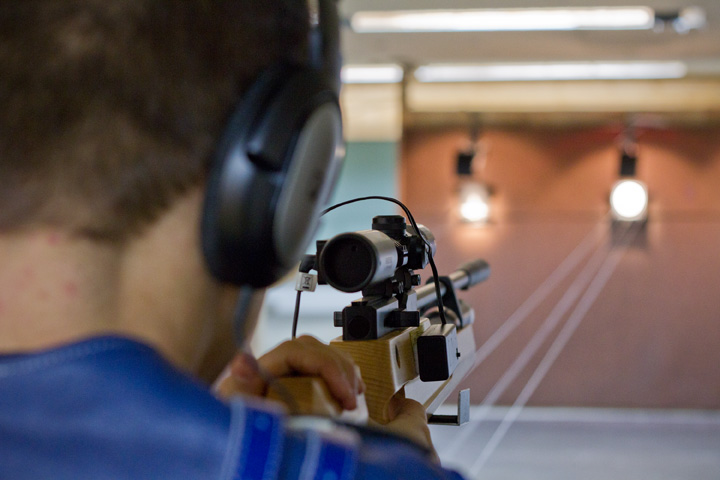
Last week I completed my story of Joe Stinton, a thirty-seven-year-old blind shooter from Helston, Cornwall. Joe shoots every Wednesday afternoon at Helston and District Rifle Club as part of the Cornwall Blind Association's club programme which started in 2002 (the club itself was originally set up in 1939, and is still used to this day for amateur shooters young and old).

Joe is an incredible man, and an extremely talented shooter; but he hasn't been blind from birth. As I found out upon the second time of meeting him, Joe had his sight for nearly thirty years prior to going blind. An unimaginable event, which took place in 1998, meant Joe would be rendered completely blind for the rest of his life.


Joe is both diabetic and wheat intolerant (two conditions which are often thought to go hand-in-hand). It was around the first anniversary of his marriage that he had a severe reaction to wheat, hospitalising Joe immediately. To help with the reaction - which saw Joe in a coma on the day of his anniversary - he was administered immunosuppressant drugs. However, whilst in most cases people with their immune systems down are required to stay quarantined in the hospital (for example after a kidney transplant), Joe was discharged, and allowed to walk free with a severely weakened immune system. It was then that Joe contracted septicaemia, a form of blood poisoning which, in severe cases, can result in blindness. Joe would never see again.

But he does not dwell on it, and is grateful for having "built up a good life" and "met some amazing people". "I have done a lot of things which I wouldn't have if I hadn't lost my site" said Joe of the fact that, apart from shooting, he has cycled tandem from John O'Groats to Land's End. 


Joe relies on a laser fixed to the gun's barrel  to 'see'. The laser points towards the target, resulting in a high pitched noise to be relayed to the headset; the higher the pitch, the closer he is pointing to the centre of the target. Once all his shots are fired, the target is pulled back to the Joe via the rope and pulley system for inspection.   


There are two disciplines in blind shooting: Supported and Unsupported. Quite self-explanatory, Supported shooting is with the use of a tripod and a chair; Unsupported is with neither. Of course, shooting unsupported is far harder, and only Joe and one other shooter at the club are skilled enough to do it. 


Joe's gun


Joe has been shooting since 1999, stopping only momentarily when his child was born. He has been selected twice to compete in the World Championships, and last Friday he competed, along with the rest of the Helston team (which consists of around eight other blind/visually impaired shooters), at the British Blind Shooting Championship in Wolverhampton.


Keith Busby is Joe's 'helper', guiding him only for manoeuvres which require more dexterity than average - for example: as he moves from the waiting room to the shooting range, loading the gun, and the initial aiming of the rifle.  


Helper Kieth Busby acts as Joe's eyes when initially aiming the gun towards the target. After that, it is all down to Joe.


Keith inspects Joe's target after a round of shooting.


A perfect score of fifty. Joe gets five shots before the round is over; the bullseye is worth ten points. During competition, however, the competitors only have two shots per target, with thirty targets to hit under timed conditions. 


This series of photographs will be edited down to just a five-picture story for my 'Fragile' assignment. My next assignment will be based around the idea of 'Touch'. 

S


Tuesday, 6 March 2012

magazine spread mock-up, MKI...

Easter is drawing ever-closer, and work is piling ever-higher. But all is good, because, for the first time since starting university, I think I am actually on top of it all. This is mainly because I have got in to the habit of paying frequent nocturnal visits to the campus library - as I am now, at 22:30pm - which gives me room to breathe away from the cramped, noisy, humid, tacky, Ikea-furnished confines of student accommodation. 

Anyway. A new module which I have been working on over the past few days is Narrative, and is all about how image and text come together in a holy matrimony of typography to tell a compelling story. The majority of this module is based around viewing and reviewing book, magazine and journal layouts, both historical and contemporary: what looks brilliant? What looks bloody awful? And believe me, there is far too much of the latter. A good place to start with this is Issuu, an online community which allows anyone around the world to upload magazine-style spreads. It is a wonderful tool for self-publishing and is full of inspiration for all thing typographic - I suggest checking it out if this subject is your proverbial cup of tea - see: http://issuu.com/  

The key aspect of this module, then, is to create our own 'mock-up' magazine spreads using images from any one of our projects so far. I will be using images from my recent shoot with the homeless in Newquay, titled Shelter. The first draft of this can be seen below. I am quite happy with the results thus far; however, there is still a lot of room for improvement: I'm not sure if I like the placement of the images on the 3rd page; I am not entirely happy with the title font; one of my negs needs cleaning... You get the idea. And before you read the text and think, "hold on a second, this isn't English", well that's because it isn't. It's what we call in the industry - I think I am allowed to say that by now - 'placeholder text', which is basically a business-ey term for "I haven't thought of anything to say yet". Enjoy.

S


Mock-up magazine spread:


Pg. I


Pg. II

Pg. III

Sunday, 26 February 2012

update...

So things have slowed down a bit since the influx of comments and page views I received after posting my work from the Newquay shoot. I would like anyone who is interested to know that I am still continuing the project, however it is going to be a longer process then I previously imagined. And for those of you who care, that post has received over 300 hits and has got a couple of comments from civilians of Newquay, not to mention the fact that Denise - the ex-social worker - got in contact with me via this blog to help me with the project.  

I have visited the homless guys in Newquay three times now, each visit being averagely six hours in length; however, during this roughly eighteen hours of contact time I have only shot one roll of film. It is going to be more difficult than I anticipated to fully gain their trust, and I have not yet reached the point where I feel completely comfortable pressing the shutter. Sometimes I get frustrated, and think "why am I really here", but then I remind myself that this is quite different to anything I have done before and that these people have every right not to be comfortable with me yet. It's funny, really, each time I leave I feel a pang of disappointment because I didn't shoot anything, but then I think of how far I have come already in terms of trust - I have already gained the nickname 'Paparazzi', and word of my presence has apparently spread - and I am filled with a new sense of determination to keep on returning and fulfilling what I have set out to do. It's almost addictive, in a strange way -  I always look forward to my next visit, knowing that I probably won't be able to comfortably photograph again, but I will be one step closer to doing so.

Next weekend should hopefully see a breakthrough; I will (hopefully) be spending the day with 'Chris the Fish', a rough sleeper who works on a charter fishing boat. He does not get paid for the work, but - in his words - "it keeps me off the street and out of trouble". It is a great example of how willing some of these people can be, and I really hope that I can get permission from the skipper of the vessel to allow me to come on board. 

I have come to realise, also, that the only way for me to be completely accepted in to this community - and to really experience what it is like to be homeless - then I need to rough sleep with them. I have had this thought in the back of my mind since I started this project, and it is only now that I fully realise it is exactly what I need to do. If I am to tell their story it can't be from me just turning up on the train every Wednesday and Saturday and then going home again in the evening - that would be hypocritical of me to say the least. I need to immerse myself in their lives, to feel what it is like to sleep in a shelter or a squat or an abandoned caravan or a tent on the headland. Only then will I be able to photograph their story. [pause for effect. end of dramatic speech]

S


Saturday, 18 February 2012

burger king breakfasts and horizontal rain...

Today I travelled to Newquay to meet with Denise Harrison in order to discuss plans for my on-going documentation of the homeless in the resort town. Denise is an ex - but by no means abdicated - drugs/alcohol support worker. She is currently working as a waitress, but plans to be returning to the care industry very soon - by any means necessary!

As I mentioned in my previous post, Denise came across my blog - and subsequently my article about the homeless - after a friend of hers came across my site. She immediately emailed me, asking if I would work along-side her to raise awareness about these troubled people of who she cares very dearly. Denise's dedication to these people is quite astounding, equal only to the infamous reverend Chris McQuellin-Wright of St. Clumb Minor church. In fact, Denise and Chris are close friends, and have been working together for a long time in an attempt to help those who do not have a roof over their head. It is at this point, however, that I regret to say that Chris' night shelter scheme for the homeless at his church has been closed down due to the bombardment of abuse, trouble and stress that he received after selflessly helping these people. All the more reason for this to go ahead, me and Denise cogitated.

I was to meet Denise at St. Columb Minor Church at 10:30am to kick things off. After digressing immediately after arriving in Newquay for a Burger King breakfast (x1 bacon, egg and cheese muffin, x1 coffe) I arrived at said church for a twenty-to-eleven. We got talking right away about our plans. The first thing I wanted to make clear was that this was going to be a long process; it would most likely be weeks before I gained the full trust of these people in order to create a portfolio of work that was strong enough and intimate enough. The second thing I made clear was that I would need Denise's help only in gaining preliminary access to the homeless, via the extensive contacts she has in the soup kitchens and charity distributions across Newquay. After that, I would hope to reach the point where I could simply turn up to a soup kitchen, or even just a street corner, and begin photographing straight away, alone, without the people wondering who I am. It is only when I reach this level of trust that I will be able to get the most intimate work.

Then Denise hit me with a bombshell - or rather, two bombshells. Firstly She has already been in contact with a gallery in the town centre who are more than willing to exhibit my work once it is complete. I spoke to the owner of the gallery later on that afternoon, and this was indeed the case. Secondly: Denise has gotten in contact with the managers of the likes of Ed Sheeran and Newton Faulkner to organise pop-up gigs in the St. Columb Minor church to help raise funds for the homeless-helping organisations - events at which I would also exhibit my work. She was so enthusiastic, in fact, that she even went as far as to email my work to the guys themselves. How that will go down remains to be seen. If we could pull it off, it would be amazing, but don't quote me on this.

Needless to say, after Denise dropped the latter bombshell, I was nearly rendered speechless. I'm not quite sure how this has all happened, but I liked it. 

After we finished conjuring up all sorts of whimsical ideas, Denise decided that she would show me a few spots where I would most likely be spending a lot of time over the next few months. We made our way in to the town centre to see if we could find any of the regulars hanging out at the L shape on the barrow fields, just outside of Newquay town centre. On the way, Denise gave me a swift low-down of how she ended up out of the care business - predominantly through the recent 40% spending cuts in the public sector.

It was at this point in time the Cornish weather system decided that it was bored with regular climes, and instead it decided to rain horizontally and painfully; this is an occurrence that I am by now more than accustomed to.

We did in fact find what we were looking for at the L shape: three or so rough sleepers sitting and socialising. One of them was Lee Parkinson, whom I photographed the week before. This made the introductions a lot swifter and easier, and before long me and Denise were chatting to them and explaining to them what we were planning to do over the coming months. Of course, we were met by scepticism and accusations of ulterior motives at first - and rightly so, people in their position have every right not to trust everyone who comes their way. However, after I explained to the others how I photographed Lee the other day - and the dropping of the name 'Chris the Vic' - we were well on our way to getting a positive response. This encounter made me realise just how difficult it may be to gain the rough sleepers' complete trust, however, and as we left the group behind I was hit with a sense of tangible realisation, and not to mention awareness of the fact that this is the first time I will be dealing with a real-life subject off my own back. This was an especially poignant feeling after the initial jubilation of the morning's excitement.

The rest of the day was spent battling with the Cornish maelstrom, going to Subway and meeting up with the owner of the gallery which Denise spoke of earlier that morning. Appropriately titled The Gallery, the humble space, which is situated in Central Square at the heart of Newquay, is run by Ruth Arron. I showed her my recent work with the rough sleepers, and she was delighted to discuss my exhibiting there. Once again, I made it clear that it would most likely be several months before I come even close to having an exhibit-able body of work. She understood, and told me to keep in touch.

My next visit to Newquay - and most likely the official start of my project - will be on Wednesday next week, where Denise plans to introduce me to the good people who run the charitable soup kitchens at St. Michael's church.

I've written too much.

S


Saturday, 4 February 2012

home on the range...

According to BJP writer Jonathan Eastland, there is no better camera than a rangefinder for shooting the human condition and everything in-between. According to a recent article of his on the photography giant's website: "They still can't be beaten for candid shots", (you can view the full article here: http://www.bjp-online.com/british-journal-of-photography/opinion/1934356/home-range) 

So, I decided to take Jonathan up on this. Armed with a Canon Canonet QL-19 rangefinder I recently obtained (curtsey of my girlfriend) I hit the streets of Falmouth for some good old fashioned street photography.

Things did not get off to a good start, however. The transparent image which one moves using the calibrated wheel on the lens has severely faded on this model due to age; this made focusing somewhat of a challenge as all I could see was a minute square in the centre of the frame on which to focus. To make matters worse, as I got in to town I discovered that the camera's meter had also deteriorated severely, even after purchasing a new battery cell. So, with a rangefinder which was practically nigh on impossible  to focus, and a light meter which constantly told me I was over-exposing , I was ready to begin. Aren't analogue camera's fun? 

It had been quite some time since I had last indulged in street photography, so at first things were a little bit rusty. As I made my way through the streets of Falmouth I felt the damning eyes of the public fall on me and my camera once again ; I could almost hear the thoughts of condemnation from every mother with her child and every OAP with their dog as they blamed me and my camera for everything that is unjust in this world, as if  at any moment I was about to throw my camera down and kidnap their child or, in the case of the grandma, her Westie.

That aside, I found that I had missed partaking in a bit of street photography, and what ensued was an enjoyable little shoot on a sunny winter's day. I find it interesting how people always think that I am using my camera for sinister and nefarious ways... An argument for another time.

the old man on the pier shot

the old woman in the street shot

Ryan in his wood cutting shop near the Princess Pavilion in Falmouth.


I cam across Ryan as I was wandering around town. He runs a small wood cutting shop which is attached the front of his house, selling souvenirs, puzzles and picture frames to any willing tourists.


Apologies for the graininess of these images, but as the meter on the camera was broken, and as I had no hand-held meter, the images needed quite a bit of work on Photoshop to bring out some contrast and tone. As this was just a test shoot I wasn't particularly bothered with the outcome, and in fact I quite like the shots of Ryan in his workshop - why did I not photograph him for The Person at Work?

As my vogue moved from old people to the soft light emanating from the setting sun, I made my way down to Gyllyngvase Beach to capture some wonderful  'people on the beach during a sunset'  shots... 


Gyllyngvase Road

This picture would be right at home in a hipster's "my favourite photography" shoebox

A brave, brave sole prepairs to face the Atlantic with just a wet suit and testicles made of iron ore.

A kayak instructor being accosted by a pair of beach ramblers.
As you can probably tell, all was going swimmingly. Until this happened:


A clusterfuck of photography. 


Upon processing the film, it became apparent that half way through the shoot my camera decided to give up on normal image making, and instead focused its efforts on producing images which looked more like a fine art photographer's third-year thesis. Nonetheless, the effect is mildly entertaining and, I suppose, typical of the charming personality for which beaten up film cameras are known... or something.

I think this old rangefinder is in need of some TLC.

S