Showing posts with label cornwall. Show all posts

Saturday, 28 April 2012

Nice day for a wedding.

Last week I photographed a wedding for the first time. I'm not going to lie - it was a pretty nerve-racking experience, to say the least. And to be honest, it made me realise just how difficult it is to take interesting photographs of weddings. The day mostly went to plan - minus a completely cocked-up beach portrait session at the end (thanks to the mini-sandstorm that appeared on Porth beach). A few lessons learnt and another shoot wiser. Below are a selection of my more preferable images.

My attempt at 'marrying' documentary and wedding photography. 


"One ring to rule them all..."


All images copyright to me, of course. Thanks to Denise Harrison for a wonderful day!

S

Tuesday, 24 April 2012

A catch up on all things photographic or otherwise.

Evening all (or morning, rather, as it is approaching 1am as I write this). Things have been stacking up rather a lot recently - Uni. work, exhibition planning and generally having a life - and so updating my blog has taken somewhat of a back seat. It has been over a week now since I have written anything on here, and quite frankly I feel guilty. Perhaps this is a state of mind I should be worried about, feeling guilty for not talking to a computer, and I should possibly contact a psychiatrist. Anywho. This post is to catch up on the rather large backlog of news, information and thoughts from the past couple of weeks.

Let's start with a couple of said thoughts. Over the past few weeks I feel I have discovered a few things about myself - or rather about how I relate myself to photography. It all started when a friend of mine came very close to leaving the Press & Editorial Photography course; the reasons: because so far we have simply been filling crappy sketchbooks to meet deadlines; because photojournalism appears to be too exploitative; and that the photography industry is apparently full of arseholes. A fair critique, I felt. It got me thinking, too, about whether this was the right place for me. Sure, I have been having a great time meeting interesting people and learning a myriad of new skills, but what was I actually achieving? Like my friend, I had thus far only been shooting work for the briefs, and not shooting anything personal for myself. Furthermore - as we engaged in many disparate conversations about the world of photojournalism - it was becoming increasingly apparent that photography is one of the most egocentric mediums, with a who-owns-the-best-camera mentality giving birth to a breed of people who seem to think that because they are a 'photojournalist' they have the right to poke their lens in to other peoples' private affairs. And I should know - I've done it myself. The very project I am working on at the moment appears to be everything I have come to dislike about certain aspects of photojournalism.


The aforementioned project is about the homeless of Newquay (and everything surrounding their lives), with the hopeful intention of shedding light upon an area often fogged with doubt and uncertainty. I have also begun to photograph the lives of young adults (16-25) who have either run away from or have been forced to leave their homes. Instead, they live in a small flat in the centre of Newquay as part of what has become known as 'The Turnaround Project', or 'Turnaround' for short. Turnaround - a Christian organisation - aims to accommodate, rehabilitate and educate the youngsters, as well as teaching them to be self-sufficient around the home and their general lives. The images so far go a little something like this:


As I mentioned before, I have been having somewhat of an inward-facing battle with myself over the past few weeks about the ethics of this. In one hand the Turnaround Project are happy for me to be there, and the youngsters themselves appear to be comfortable. But as I thought about how I first introduced myself to their lives, I realised just how ridiculous it sounded. I am conducting a 'project' - I have also come to dislike categorising people as 'projects', but it will do for now until I can think of a better word to apply - on the homeless population of Newquay, ranging from rough sleepers to, in the case of Turnaround, the accommodated, but all are without any real 'home'. What, then, has given me the right photograph these people? These people who, in relation to me, have nothing (although the youngsters at Turnaround have come to call the apartment home, it is not exactly the same deal). When I really think about it, the only reason why I chose to do this 'project' was because I simply got lucky with the access way back in February. But to tell you the truth, I believe I have matured as both a person and a photographer since then, and I that simply "having access" doesn't constitute a reason for carrying out a 'project'. I want to do a project about something that I feel moves or inspires me - not that a lot of what I have seen doesn't inspire me, I have met some amazing people - but, and again I go back to the reason why I started this in the first place, I don't feel as though I truly deserve their attention. It is almost as if I am making a story just becuase of their position in life, which makes me feel very uncertain as a photographer. These days, I find that the stories that hold me the most are not this which document hard core subjects such as homelessness, but smaller stories which make you think - "wow, I had no idea such people existed". A great example of this is a recent piece by r Jono Rotman, who produced some amazing - but simple - portraits of the Mongrel Mob, a New Zealand-based gang. This work for me made me realise just how effective a simple body of work can be.

Back to the matter at hand, and of course, if I could help any of these people in some way I would be extremely happy. In fact things are already beginning to take shape in regards to different charities. I have recently been in contact with a representative of Emmaus UK, one of the biggest homeless charities. Conversation has started in regards to exhibiting my work as a fund-raising tool as well as general propaganda. And that, I think, would give me the right to photograph these incredible people.

As far as everything else is concerned, things are going swimmingly, albeit extremely busy. My year and I are ploughing ahead with exhibition planning, with the whole thing starting to shape up rather nicely. Follow this link to the Pig House Pictures Facebook page (see previous post for details on that). We have also organised a smashing after-party to be held at Toast in Falouth to really see-off the opening night of our first year exhibition (which will be on display at the Royal Cornwall Polytechnic Society from the 8th - 14th May). As well as all that, we also have plans for a pocket-sized publication in the pipeline; more on that to follow soon!

Oh, and before I forget, I have photographed my first wedding! ("Hoorah", "Hazzah!"). The big day was last weekend, in fact, and was a friend of mine's in Newquay. It was quite a nerve-racking day to say the least, and needless to say I learnt a fair few lessons in photographic management! But enough spiel for now, stay tuned (if anyone does indeed 'tune' to this) for wedding photographs galore. I'm not entirely sure if I should be admitting such a thing on a photojournalism blog.

S

Saturday, 14 April 2012

Pig House Pictures


So, here it is. The culmination of a year's work for the first year Press & Editorial Photography course in the form of Pig House Pictures: a new collective made up of us, the first years! I have to say that I was losing faith in the course a little due to the fact that, after nearly twelve months of solid work, nothing productive - or should I say 'professional' - had come from it (i.e. all we had been doing was producing work to fit briefs and fill sketchbooks). So, instead of waiting to be miraculously picked-up by an agency some time in the very distant future, we decided to make our own photographic collective (yes, it really is that easy).

According to the Pig House blurb (tastefully written by myself): "Pig House Pictures is a new photographic collective based at University College Falmouth, Cornwall, specialising in contemporary photography. Conceived in 2012 by first year students of the Press & Editorial Photography course, the Pig House’ aims to move beyond the confines of traditional photojournalism. Drawing inspiration from a wider circle of influences, we plan to bring local, national and international journalism to the masses through accessible and contemporary photography."

And things are already beginning to take-off. We have organised an exhibition at The Royal Cornwall Polytechnic Society in Falmouth from the 8th - 14th of May (plug, plug), showcasing a year's work for us. We are also in the process of constructing an online magazine which will be featured on Issuu.com, a self-publishing website. It will look  a little something like this (excluding the front cover; that one's a surprise):


Designed by myself and my good friend Artur Tixiliski, the layout will follow this general style (although it is still in its 'beta' stages and will probably be changed a few more times until everyone is happy). When I say everyone, I mean my course-mates, because that is the whole idea of this scheme: to be democratic. We have numerous people from the first year working on this, and they have been allocated certain positions: designers, writers, P.R., advertising etc.

Once again, if you are in the Falmouth area over 8th - 14th May, check out our exhibition - 'I'. Next stop world domination I guess...

S

Sunday, 8 April 2012

A Shot in the Dark, magazine layout MKII

After deciding that I was not happy with my previous layout, which had too much text and not enough emphasis on the images, I have produced a revised version of my magazine layout for my story on blind shooting. I believe that the layout is far more simple, with not too much text. Discuss. 

S


Friday, 6 April 2012

A Shot in the Dark, magazine layout

Below is a magazine layout which I have produced for my five-picture story on Joe Stinton, a blind shooter from Helston, Cornwall. The layout will be submitted for  a module on layouts and typography, and will also hopefully b making it to Pig House Pictures' online publication on Issuu (more on that exciting development to come). For now take a look at the two spreads and hit me with some good old fashioned criticism; and on that note, I would just like to say that I do not like the second page of this spread. We are limited to using two pages only to fit five images on, so it is a bit of a tight squeeze. 

S


Friday, 30 March 2012

CARTEL PHOTOS

Follow this link to watch the recently-made promotional video for Cartel Photos, the agency based here in Falmouth which represents myself and everyone on the Press & Editorial Photography course. It is a brilliant initiative which allows us students to gain invaluable experience in working professionally and make money from our work. Over the past year alone 'the Cartel' has gained significant interest from major agencies such as Rex Features and Panos Pictures  , who have begun to act as the leading 'tutor' for Cartel Photos. Enjoy.

S

Saturday, 24 March 2012

photojournalism guru David Campbell...

David Campbell


For those interested in intelligent journalism and arguments, looking at the words of writer and producer of photography David Campbell would probably be a good idea. Campbell's aim is to "analyse the contexts that shape visual storytelling, so we can produce better photographic and multimedia work".


Sounds good, and it is. Go figure. 

S 

Thursday, 22 March 2012

we're all hypocrites...

As I seem to have somewhat of a hiatus in regards to the amount shoots I am doing at the moment, I find myself thinking more and more about, well, nothing in particular, but everything at the same time. For example, just two days ago I appeared to have a Platonist discussion with myself about whether photography really should be as objective as everyone says it does. Sure, in journalistic photography, putting a truth-less spin on an image - specifically with the use of misleading captions - is pretty much like putting a gun to your head and saying goodbye to your credibility (note the uproar regarding the misleading caption TIME set against the portrait of Afghan woman Bibi Aisha, discussed quite elloquently here by photographer  David Campbell). 

But - and this is a big but given that I appear to be going through some sort of philosophical epoch - I see photography as being a very personal medium. As photojournalists especially, but this can apply to all walks of the medium, we photograph the way we see things, surely? I do. Of course, without the subjects being there, doing what they are doing, there would be nothing to photograph; as Salgado said: "The subjects make the picture, not the photographer"... at least I think he did. Anyway. Ultimately it is the person holding the camera who decides how to photograph the situation and, whether they like it or not, the resulting image must, in some minute way, be influenced by the way they feel about said situation. Take, for example, pretty much the entirety of Martin Parr's work. No matter how much he says that he was merely documenting what he saw and not shooting to criticise or judge, one cannot look at the images and believe that there was not at least a glimmer of judgement involved - otherwise he wouldn't have photographed such subjects as pasty Englishmen on a beach burning there bald heads. There must have been a time whilst shooting the content for, say, The Last Resort when he saw a fat bloke with a bacon sandwich in his hand and thought "Yeah, he looks stereotypical enough". I'm not quite sure where I am going with this subject so I will leave it there. Like I said, it was just a thought.

What I really wanted to talk about in this post was concerning the recent rant I had about a few aspects of photography which get on my wick, namely 'over-networking' and hypocritical exhibits. Now, I met quite a bit of opposition from a couple of people who read the post, and I admit I may have been a tad brash in a few of my statements - being unable to sleep and a throat infection does nothing for my mood - but I still stand firm in my most basic of points. One of said points was that I believe too much time is spent networking (I will use this term instead of 'ass-kissing' from now on). After splattering my blog over Facebook and Twitter I got varied responses, some agreed, some disagreed, and some were indifferent. One person who took particular interest was Holly Hayward, who decided to construct a far more level-headed approach to the argument. I tip my hat to her. She too agreed on "The apparent need for photographers to be accepted and ‘liked’ by other industry members". But as I sat back and watched the discussions flow on both social networking sights, I realised that in writing what I did about 'over-networking', I too was in fact networking, in some small way, myself. After just a few hours my blog post had worked its way around the Press & Editorial Photography's Facebook page; a few family members and friends picked up on it after I posted it on my homepage. From there, my course tutor picked it up as well as my second year mentor Jon Brownhill. Jon subsequently posted it on his Twitter page with the caption "Some more thoughts of a young photographer, probably soon to be followed by my own". Once on Twitter the post was viewed by a couple more second years as well as the second year's main tutor Tom Ingate, who commented "Some interesting points that need discussing". Before I knew it my post had nearly 100 views in just one day and my name was known by a few more photographers, however local to Falmouth.

My point is, if there is any point to this post, I'm not quite sure, that we are constantly networking ourselves by maintaining blogs and websites such as my own. As David White said on his particularly well-known blog Duckrabbit: "You are the mainstream media. You and your friends, and your friends friends. You’re the wires and you are the electricity along which the message travels, and if you want to be, you can even be the message too.". Obviously there will always be the need for physical networking (not too much, mind), but it is an interesting thought nonetheless (my life seems to be full of 'interesting thoughts'). 

Before signing off and posting this blog on to Facebook and Twitter once again, thus advancing my mediocre rise to global photographic domination, I would like to refer back to Holly's post again, in which she pointed out how, to paraphrase, there is too much time spent worrying whether a subject has been 'done before'. As she put it: "if we want to raise awareness, then surely that can only be positive?". I must admit I have had such incriminating thoughts about the project I am doing with the homeless of Newquay at the moment, but upon reading what Holly wrote I decided this: Haters gonna hate. The same can be said about a few of the negative reactions I received from my original rant. 

I'm pretty sure none of this makes sense.

S


Wednesday, 21 March 2012

Another thought...

Following from the monologue that I posted last night during a man-flu-fuelled rant, I would  like to amend - or rather explain - a few of my points, specifically the ones regarding photographic brown-nosing. 

After sharing and discussing the post with a few of the guys on my course, the point was made by one that I appeared to be saying that I have a problem with being nice in general, and that I should be nice to a publisher or printer or curator just as I would be nice to a barman - because it will get me served first. A very valid point, and so I would like to say that I do not have a problem with being nice in general, although my outlook can be a little frosty at times, that is just the way I am. If a person is worth being nice to then of course I will nice to them. If I am completely honest my post last night was making a rather sweeping statement of a few things I saw that week in London - not all - but a few. Of course, it helps to be civil to anyone in business, that is pretty much what most good business is built upon. I would like to say, though, that if I want to make friends with someone - be it within the industry or not - I would want it to be on the basis of mutual respect rather then where they work. Furthermore, if the work that you are pitching to a publisher or editor, and if the pitch is done well, then it should speak for itself no matter your history with them.

Of course, I have zero experience in the industry at this moment in time and I will probably regret writing all of this. But for now, this is my opinion.

S 

Tuesday, 20 March 2012

the thoughts of a young photographer...

Recently I have been engaged in an on-going argument between myself and photography - more specifically, the photography that I am creating. The argument started after I had a discussion with one of my course mates about how they were considering leaving the Press & Editorial  Photography course. When I asked my good friend why she was considering changing courses, her answer was because she felt as though she was spending too much time (and money) photographing things that she simply did not care about and that would ultimately end up counting for nothing; after all, we are not being paid to be at university, and nine times out of ten the work we are completing in this first year will spend the rest of its days glued in to a bloody work book. What we are doing, though, is spending hideous amounts of money on consumables such as paper and film and driving ourselves in to massive debt which we probably won't pay back for another twenty years or so.

Of course, by signing up for university we are putting ourselves in to immediate contact with connections within the photographic industry - two of my three main tutors are industry professionals (Guy Martin/David White), the other being retired from industry work but still has connections in all the right places. In the second and third years we will be given the opportunity to take work placements at such major agencies as Rex and Noor, which will no doubt put us in the right direction to working professionally. But this idea of 'connections' is something that - for some reason that I can't put my finger on - really bugs me about photography. It is something that is evidently important, of course, without knowing the right people, or without them knowing you, how are you going to get jobs? Or get your work printed and shown in the right places?

Connections are fine in that sense - crucial, even. What I cannot stand about the photographic world is the brown-nosing, the ass-kissing, the cock-sucking - however you want to say it. I spent last week in London with my course and a handful of second years, visiting galleries, independent printers, agencies and labs as part of a field trip. Before entering each establishment we were encouraged on nearly every occasion to "be nice" to the people who ran the exhibit, gallery or agency, because they may just remember you for it. Well, apart from making me feel about three years' old, it made me want to hit the next fashionable art curator I saw. Why the fuck should I "be nice" to anyone? If I wanted to get my work printed by a lab or a digital printers, then I would ask them, and they would subsequently take my hard-earned money because, and correct me if I am wrong, but I am pretty sure it would be considered bad business if a company declined a client on the basis of not being their friend. This theme was carried throughout the week; I witnessed, for example, a second year explain to the organiser of Labyrinth Photographic Printing how "he would like to keep in contact" and subsequently handed the man his card... I felt as though I had been transported in to Brett Easton-Ellis' American Psycho, where the metaphorical size of a man's penis is judged by the quality of his card. And that is, really, what photography boils down to - if you have money, then it would appear you can do whatever the fuck you like.

Unfortunately, I don't have a lot of money, and neither does my friend who sparked this argument. So where does that leave us? Quite frankly I don't know. All I do know is that I will continue doing this course until something happens - by 'something' I am talking along the lines of an internship or similar. Of course, it would be all too easy for me to complain about the ass-kissers if I were not trying in some way to gain connections through methods that do not involve blowing the wind up the ass of a curator. I am proactive about what I do, I am currently under-going a project with the homeless people of  Newquay (and before you sigh and dismiss it as something everyone has seen before, that is something I am well aware of and intend to stay well clear of it). Off my own back I have gotten in contact with numerous organisations who are doing everything humanly possible to help these people, ranging from soup kitchens and food banks to the Turnaround Project, an organisation which accommodates 16-25-year-old people with no home. I am receiving help from an ex-social worker to get contacts within the world of the homeless and we have already begun liaising with a gallery in regards to exhibiting the work once it is finished. It is here, however, where I stumble across the second half of my dilemma: exhibiting.

Nia Haf, a second year on the Press & Editorial Photography course, recently wrote on her blog  how exhibiting work of "death and destruction" can appear to be  rather counter-productive. In her argument she used the example of Guy Martin's Shifting Sands exhibition that was recently shown in Falmouth. The body of work was from Guy's tour of Libya and Egypt in 2011 covering the Arab Spring (see: http://www.panos.co.uk/bin/panos2.dll/go?a=disp&_m=1&_s=1&_ml=Stories&_sl=&_tlid=2&t=gl-loader.html&groupid=13&galleryid=1318&glbid=1824&page=1&si=F89DB5CFCC4A4B4CB0FCCF3818061F&rnd=0.0, (apologies for the ridiculously long link)).

I was present at the private viewing, as was everyone else on the Press & Editorial Photography course, and I have to admit that I got very much the same feeling as Nia did. We stood there with our "expensive beer... in one hand and ridiculously tiny salmon canapé in the other" saying "I really love that frame". We viewed the images, partook in some philosophical conversations and went home after a nice, civilised evening of looking at dead or dying  people in a country so far removed from the UK. As Nia put it on her blog - "Isn't there something a little fucked up about that?".

Yes. I think there is something a little fucked up about that, which is why the last thing I want to do is be a 'conflict photographer'. It is, on a smaller but no less relevant scale, how I am now feeling about my project with the homeless of Newquay. No matter how much I get to know these people, however much I befriend them, there will always be a divide between them and I, between these incredible young people who have had no parental figures in their lives (in the case of the Turnaround Project) and myself, the hideously middle class man from a quaint village in East Anglia who also happens to have a camera in his hand. And then there is the case of exhibiting the work, ergo gaining exposure as a photographer and taking another step toward the hipocrisy that I am ultimately bitching about in this post. But I want to gain exposure, right? Isn't that what we as photographers do? Otherwise there would surely be no industry. I keep telling myself that I am doing the project to (and I hate using this phrase) 'raise awareness' of the situation, to hope that people might be interested in these incredible stories. I truly am interested in these people and their lives, but sometimes I feel simply 'being interested' doesn't quite cut it.

Thus, I have come full circle. I am proactive - but not an ass-kisser - I love photography (it is what I want to do) but in doing a project such as mine I appear to be fulfilling one of my ultimate hates about photography: hipocrisy. I want to empathise with these people and produce a compelling body of work, but at the same time - without beating around the proverbial bush - I do want to gain exposure as a photographer through exhibiting the work, which, more or less, would mean I am gaining from other's misfortunes. Tricky, huh? I guess it really comes down to how I wish to portray these people, and how I do eventually want to exhibit it, but it is constantly at the back of my mind (I then tell myself that there is nothing that can be done about the fact that they are homeless and I am not, and to simply get on with it).

I am fearful of falling in to the pit which so many photojournalists these days have fallen in to and to photograph something that might be considered 'sad', and it seems all too easy to do it. I guess in future I will just have to choose to cover something more light-hearted...

S


Sunday, 11 March 2012

recent work for the newspaper...

Gyllyngvase Tennis Courts

This group of pensioners have been playing at Gyllyngvase Tennis Courts for over thirty years - since local resident Barbara Truswell founded the club. The courts - which are currently run by the Falmouth Beach Hotel - are available for public use. Now, however, there are fears of them being taken over by St. Michael's Hotel across the road, potentially putting it in to privatisation, meaning the end of the thirty-five-year-old club.


S

Saturday, 10 March 2012

magazine spread mock-up, MKII...

The revised version of my mock magazine spread, words and all (although I'm not sure if I am 100% happy with them just yet, but the layout is about right). Enjoy!

S


Joe Stinton: a shot in the dark

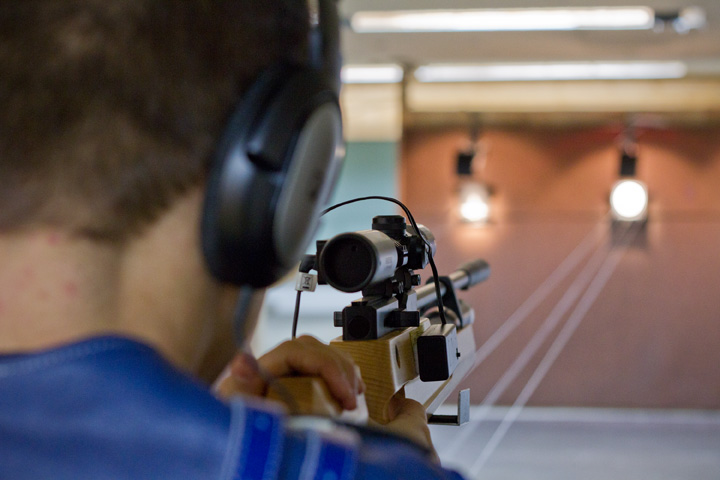
Last week I completed my story of Joe Stinton, a thirty-seven-year-old blind shooter from Helston, Cornwall. Joe shoots every Wednesday afternoon at Helston and District Rifle Club as part of the Cornwall Blind Association's club programme which started in 2002 (the club itself was originally set up in 1939, and is still used to this day for amateur shooters young and old).

Joe is an incredible man, and an extremely talented shooter; but he hasn't been blind from birth. As I found out upon the second time of meeting him, Joe had his sight for nearly thirty years prior to going blind. An unimaginable event, which took place in 1998, meant Joe would be rendered completely blind for the rest of his life.


Joe is both diabetic and wheat intolerant (two conditions which are often thought to go hand-in-hand). It was around the first anniversary of his marriage that he had a severe reaction to wheat, hospitalising Joe immediately. To help with the reaction - which saw Joe in a coma on the day of his anniversary - he was administered immunosuppressant drugs. However, whilst in most cases people with their immune systems down are required to stay quarantined in the hospital (for example after a kidney transplant), Joe was discharged, and allowed to walk free with a severely weakened immune system. It was then that Joe contracted septicaemia, a form of blood poisoning which, in severe cases, can result in blindness. Joe would never see again.

But he does not dwell on it, and is grateful for having "built up a good life" and "met some amazing people". "I have done a lot of things which I wouldn't have if I hadn't lost my site" said Joe of the fact that, apart from shooting, he has cycled tandem from John O'Groats to Land's End. 


Joe relies on a laser fixed to the gun's barrel  to 'see'. The laser points towards the target, resulting in a high pitched noise to be relayed to the headset; the higher the pitch, the closer he is pointing to the centre of the target. Once all his shots are fired, the target is pulled back to the Joe via the rope and pulley system for inspection.   


There are two disciplines in blind shooting: Supported and Unsupported. Quite self-explanatory, Supported shooting is with the use of a tripod and a chair; Unsupported is with neither. Of course, shooting unsupported is far harder, and only Joe and one other shooter at the club are skilled enough to do it. 


Joe's gun


Joe has been shooting since 1999, stopping only momentarily when his child was born. He has been selected twice to compete in the World Championships, and last Friday he competed, along with the rest of the Helston team (which consists of around eight other blind/visually impaired shooters), at the British Blind Shooting Championship in Wolverhampton.


Keith Busby is Joe's 'helper', guiding him only for manoeuvres which require more dexterity than average - for example: as he moves from the waiting room to the shooting range, loading the gun, and the initial aiming of the rifle.  


Helper Kieth Busby acts as Joe's eyes when initially aiming the gun towards the target. After that, it is all down to Joe.


Keith inspects Joe's target after a round of shooting.


A perfect score of fifty. Joe gets five shots before the round is over; the bullseye is worth ten points. During competition, however, the competitors only have two shots per target, with thirty targets to hit under timed conditions. 


This series of photographs will be edited down to just a five-picture story for my 'Fragile' assignment. My next assignment will be based around the idea of 'Touch'. 

S