Showing posts with label Metz flashgun. Show all posts

Tuesday, 17 January 2012

The Portrait element: David Shipley (35mm, B/W film)

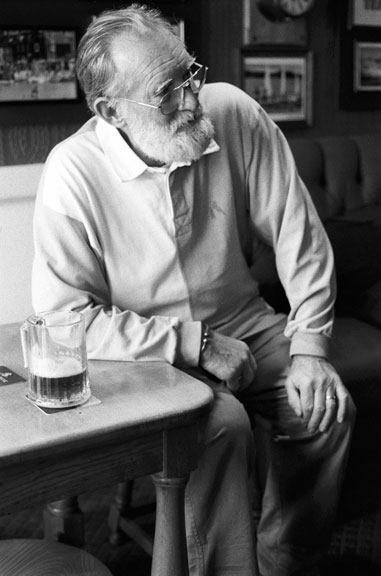
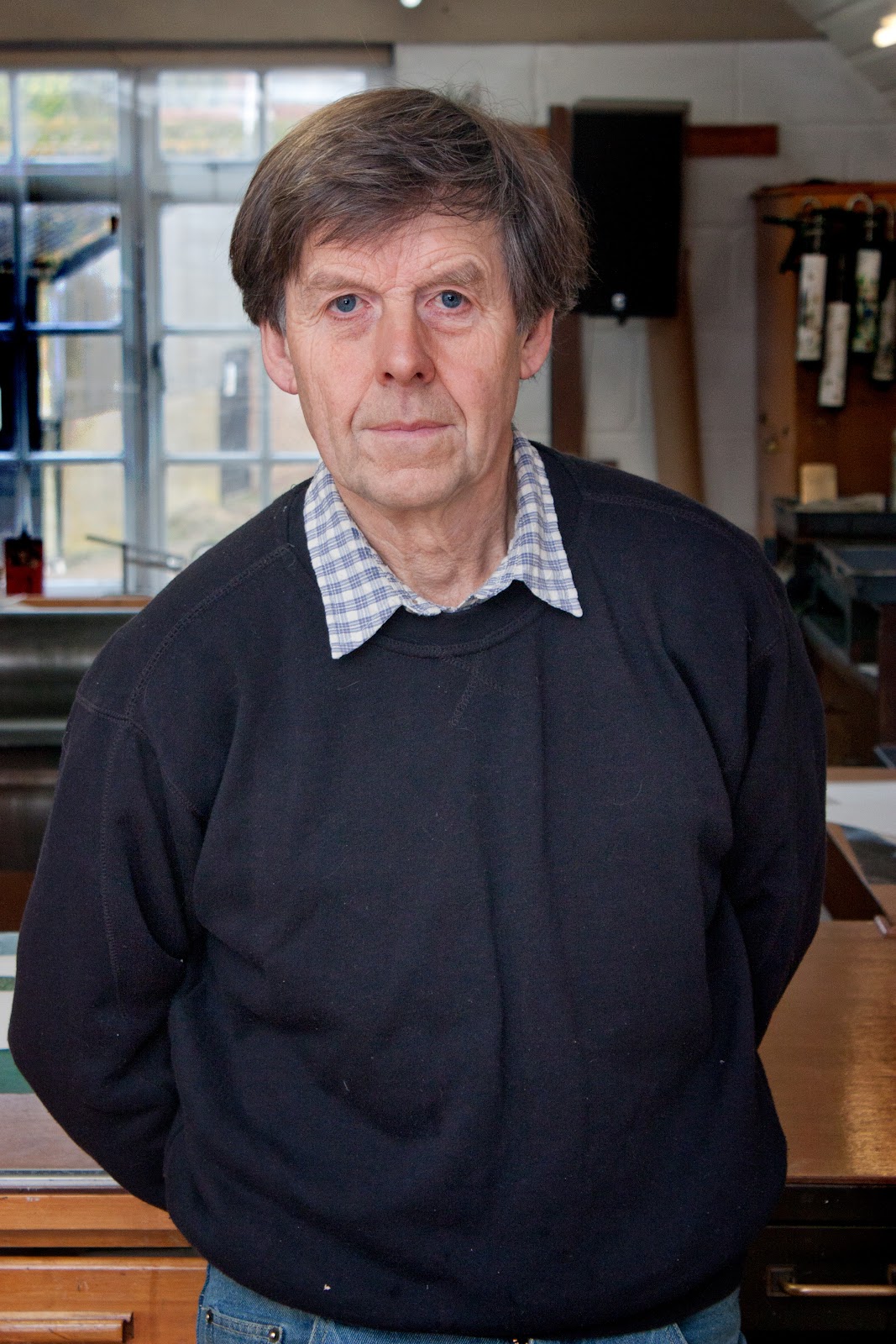
Below are the four images of ex-marine engineer/competitive sailor David Shipley which I have chosen to submit as my final images for the Portrait Element brief...


Observed portrait - ambient light

Environmental portrait - ambient light

Detail - ambient light

Formal portrait - with Metz flash


S

Monday, 16 January 2012

Playing with the 7D

This weekend I visited some family in Gloucester - to be precise, it was my nan's 80th birthday. Now being considered the 'Family Photographer", I was asked by my aunt to take some shots of the party and the weekend in general. For this, I hired a Canon 7D and two speed lights from the photography stores here at the university. This was great fun, as I have never shot digital on anything above a 450D. Below are a few examples of what I took - mostly portraits and 'family snaps'. 


My brother Rob and his girlfriend, Grace Williams

My nan holding one of her gifts - a print by Suffolk print-maker Glynn Thomas


My Cousin (left) and a relative.

My cousin's dog, Murphy.

My uncle's dog, Sophy.


Rob and Grace.


Using the 7D and the flash lights was good experience, as a few of my forth-coming assignments will be required to be shot digitally.


S

Saturday, 7 January 2012

The Portrait Element: Manningtree Sailing Club - David Shipley and Sid Smith

On Thursday 5th January, I visited Manningtree Sailing Club to photograph David Shipley - an ex-marine engineer now 18 years' retired. He is an acquaintance of my grandfather's, who is heavily involved with the club and all things nautical. We met at the Manningtree Sailing Club clubhouse, where, over  a couple of pints of Adnams, we discussed his history of sailing and involvement with the club. Below are a couple of examples of some digital work I produced on the day - as with the rest of my portrait sessions, I will not be able to process any of the films until I return to University (which is tomorrow, thankfully). Throughout this shoot I used  my Canon 450D DSLR and Olympus OM - 2n (35mm film), along with a Metz flashgun. 

David Shipley


Shipley was a keen sailor in the past, competing in numerous national and international races - the largest being the North Sea Passage race, which he entered a total of seven times and won twice. He also won the London Frostbite race three times - a race which takes competitors 32 miles along the River Thames, starting at Tower bridge and ending at Erith Yacht Club. His hay-day was cut short, however, due to the un-timely death of his friend during a boating race in Holland. Since then, Mr. Shipley has merely dabbled in sailing, buying and refurbishing a small fleet of traditional fishing boats and selling them. In between this and sporadic pheasant-shooting excursions, David has battled with cancer and is the full-time carer of his mother, who, regrettably, is otherwise incapable of looking after herself.       


David showing me a picture of his dingy on his mobile phone.


Sid Smith

Whilst photographing David, I took the opportunity to make some portraits of my Grandfather, Sidney Smith.  I have not as yet had the opportunity to undertake portraiture with a member of my family, and I found that the personal relationship made for far more successful and intimate portraits. Like David, my grandfather was, and still is, a keen sailor and an exceptional advocate of the Manningtree Sailing Club. 


Above are three of my favourite digital portraits from the day - in particular the middle and bottom portraits. I think that these are the most successful because they show the estuary map in the background - the Stour estuary being a huge part of Sid's life, which gives context to his extensive history and his love of the landscape. 


Sid posing next to his yacht

I am really happy with the results of this shoot, and I would like to carry out more photographic documentations of my family in the near future - the personal aspect of the subject matter created a very close emotional connection between me and the photographs, and a great sense of pride in the images. For now, however, I need to concentrate on my University projects at hand, which require me to deal with subjects who I am not familiar with.


Reading poetry


S

Saturday, 31 December 2011

The Portrait Element: Glynn Thomas

Today I carried out a portrait shoot with Glynn Thomas, a Suffolk printmaker who specialises in etched prints with stunning colour. Both my family and I are big fans of Thomas, and several of his prints hang from the walls in our house. His abstract landscapes depict a world with a perspective flipped on its head - roads appear to begin in the sky; huge chunks of towns and villages are flipped on there heads in a conglomeration of architecture and natural scenery. I was lucky enough to gain access to his studio, where Thomas creates his works on a traditional Victorian replica printing press. 


Thomas was born in Cambridge in 1946 and studied at the Cambridge School of Art from 1962 - 67, specialising in illustration and printmaking. He then taught printmaking at Ipswich School of Art for twelve years; now, Thomas resides in the sleepy village of Capel St. Mary in Suffolk, working as a full-time artist. He has illustrated a number of books and is a Fellow of the Royal Society of Painter-Printmakers; at the Society's 1983 annual exhibition, his etching 'Honfleur', was awarded the Davys' prize for the best print.


Portraits


Glynn poses next to his traditional Victorian replica printing press.


I felt that this shoot was far more successful than the one at the Pinkuah Arms last week - above are a few examples of the portraits I took using my DSLR (as with the previous shoot, I will not be able to view the film exposures until I return to University). 

There was far better light in his studio than in the Pinkuah Arms, and the room was infinitely more photogenic. With Glynn I felt a lot more comfortable and a lot more confident in using the flash gun, I was also far more proficient in the positioning of the subject. Furthermore, I was far more aware of composition, spending  more time on each shot - making sure I bracketed (when shooting on film) and taking the time to talk to Glynn between shots to create a more comfortable atmosphere. After about ten minutes I was shooting without doubt in my exposure or composition.


Above are my three favourite portraits taken on my digital camera - if I was to decide an ultimate favourite from the three similar frames, it would probably be the very top image, simply because of his more relaxed stance and the way I shot from below, giving a far more interesting composition.

I am particularly proud of these shots because I believe they are the first time I have managed to truly use the Metz flash to its fullest potential - the subject is well-lit by the flash, but not overpowered by it. To help create the softer light I covered the flash head with a piece of white clothe held in place with an elastic band, helping to create a nice tonal range and a softer light, with dark hues of brown, green and blue. 


The final three portraits are of Glynn standing with his traditional Victorian replica printing press, which he uses to create his prints. I think these images are very successful, as they are well-lit and serve the purpose of environmental/formal portraits well. Again, I used the Metz flash with the make-shift soft box to create a more ambient light. Here, though, Glynn was also lit by light coming in through a window, which illuminated the scene nicely, picking up the details in his clothes and in the frame of the printing press. 

All in all, I am very happy with the results of this shoot, and I can't wait to see how the films process. Next week I am heading to Manningtree for a portrait shoot at the sailing club there - I am exciting to continue using the Metz flash more and more to keep on improving my portraits. 

S

Monday, 26 December 2011

The Portrait Element: The Pinkuah Arms

Christmas has come and gone, and it's been about two weeks since I last updated this blog. For this I feel slightly guilty, yet at the same time not, as until now I have had absolutely nothing to report. Amongst all the festivities and catching up with family and friends after returning from university, I am proud to say I have finally made  a start on my portrait project. This came in the form of Mike and Laura - a couple who run a local pub near to where I live: The Pinkuah Arms. They are a brilliant pair, and I have worked with them in the past. 


This was the first time I had undertaken a portraiture shoot, so I was quite nervous when working with Mike and Laura, even though they are not strangers to me. Because of this I found myself turning in to a blabbering mess and generally forgetting how to take a good photograph. I'm not quite sure how or why this happened, but it caused me to make some stupid mistakes - let's just say that if it were not for the wondrous, life-saving editing capabilities of RAW, this photograph would not look the way it does now. Nevertheless, I managed to get a few good shots, as seen above taken on my DSLR. Unfortunately the majority of the shoot was taken on film - as the project brief dictates - so I won't have an idea of how they turned out until I process them.  

I think my downfall with this shoot was confidence - or rather lack of confidence. I was concentrating so hard on getting the right exposure whilst using the Metz flash, I almost completely forgot about composition and building a successful rapport with my subjects. I will be returning to Mike and Laura again on Wednesday to shoot some more, so hopefully I will be able to build on what I have already done in a more relaxed nature, and not choke when it comes to stringing together all the elements for a good portrait.

S

Wednesday, 7 December 2011

Metz Flashgun

As my new assignment dictates that at least two of the finished portraits need to be lit by artificial lighting - be it flash or studio lights - I decided do some experimenting with the Metz flashguns that the photography centre has here on campus. I have never used flash with digital cameras, let alone film, so the thought of photographing with flash on my Olympus was quite a daunting one. However, I know feel more confident after having tinkered with the Metz - turns out flash is nothing to be afraid of after all!

Fill-in flash


The difference in lighting between the sunlit and shadow areas in a bright, sunny scene is often too much for film to handle, particularly when using colour film. If you expose to keep the highlight detail, the shadows will be black and empty. Using fill-in flash supplies extra light evenly across the subject. This has little or no effect on the brighter areas, but boosts the shadows dramatically to give much more preferable results. Correct use of fill-in flash should not be noticeable, and if anything will make the subject look healthier. It will also help to liven up the subject on those dull, Cornish winter days.

The general calculation for fill-in flash is 1.5 to 2 stops below the ambient light reading. For example, if I had a light reading of 1/60 at f/8, I would set the Metz flash, in 'auto' mode to f/4, and my camera to 1/60 at f/8.

Flash as main light

If the ambient light is insufficiently illuminating the subject, an alternative is to use the Metz flash as the main source of light. By simply reading of the scene, I could set the Metz .5 to 1 stop brighter than the reading, and set the camera likewise. For example, if the light reading is 1/60 at f/4, I would set the Metz, on 'auto' mode, to f/5.6 and set the camera accordingly at 1/60 at f/5.6. This will make the subject stand out on a dull and dark day.

Flash to make daylight look dark

As an aside, I could consider turning daylight considerably darker by setting the flash to 4 stops over the ambient aperture reading. This will create the look of 'night-time' in daylight. So, for example, if my ambient reading was 1/15 at f/11, this would now become 1/250 at f/11 (setting the shutter speed four stops faster). This will be difficult to achieve with a 35mm camera due to limited synchronisation speeds, but could be considered nonetheless.

My flash testing

Below are the results from my play-time with the Metz flashgun...

Straight flash:

The straight flash gave quite a harsh lighting effect, with all depth in her facial features completely blown out. I was also getting this rather annoying dark line appear at the bottom of the frame - I was later told that was due to using such a wide lens (18mm) and that the Metz work best with a 50mm prime. 

Bounced flash:


The bounced flash gave a lot more of a three-dimensional image and a more diffused light.

I will not be going on any more shoots until I return home to Suffolk for Christmas, so for now I am just getting my head down to some research and experimentation.

S